

Culture
Walking to Chartres: the revival of Catholic France
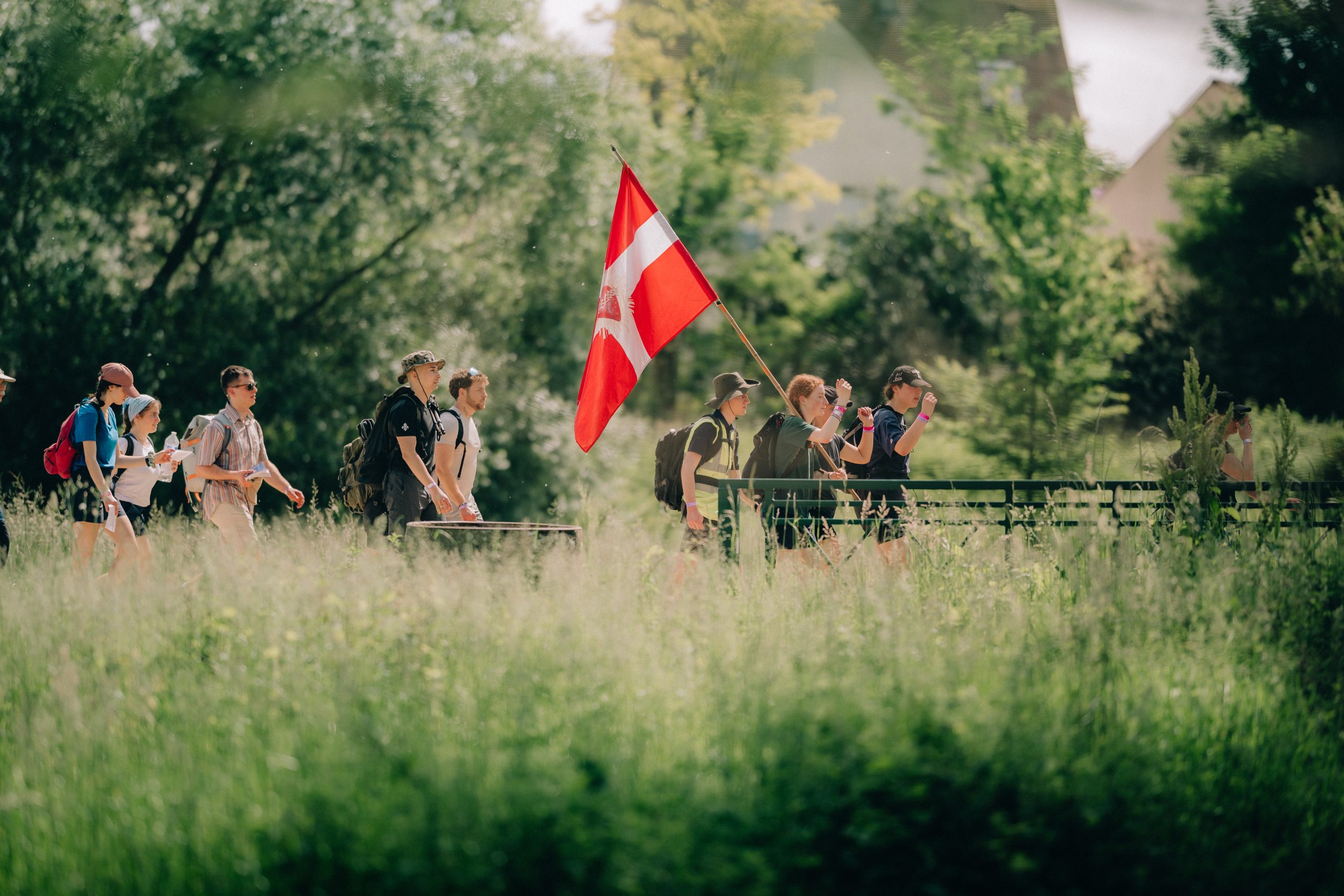
France has seen a surge in adult baptisms. At the same time, more than 20,000 pilgrims completed the three-day pilgrimage to Chartres, the flagship event of the Traditional Latin Mass movement in France. This is the story behind its remarkable growth This year’s annual Notre-Dame de Chrétienté pilgrimage saw more than 20,000, mostly young people make their way from Paris to Chartres amid a Europe-wide heatwave. It is another record-breaking year for the event, which is supported by a further 6,000 volunteers. Like much that is found in the traditional wing of the Church, the pilgrimage is both old and new. New in the sense that it has a vitality brought about by its young attendees. Old in the sense that its origins are medieval. The city of Chartres owes its association with pilgrimage to the Sancta Camisa, a piece of silk worn by Our Lady during the Nativity. Depending on the account, Charlemagne either stole the relic in Constantinople, or was given it by the Byzantine imperial family, and then in turn gave it to his grandson Charles II, also known as Charles the Bald, who presented it to Chartres Cathedral in 876. The Sancta Camisa came to prominence in 911, when Chartres was subjected to a Viking raid. Gantelme, the bishop and military leader of Chartres, is reported to have displayed the relic above the town gate. This is said to have emboldened the defenders of Chartres and terrified the pagan army, resulting in the town withstanding the attack. The episode led to the conversion of Rollo, the Viking leader, his pledge of allegiance to Charles the Simple, more charitably known as Charles III, and the establishment of the Duchy of Normandy, with Rollo as its first duke. Just over a century and a half later, that duchy would successfully invade England, a feat no one has yet matched. Over the ensuing centuries, the cathedral was subjected to successive fires. After each one, however, the people of Chartres rebuilt it in ever more splendid forms. The “Cult of the Carts”, a medieval devotion in which lay people harnessed themselves to carts in place of oxen to transport building materials, finds one of its most famous examples in Chartres. In a letter written by Abbot Haymo of Saint-Pierre-sur-Dives to the monks of Tutbury Abbey in England, Haymo described people of all social classes dragging materials to Chartres catherdral as an act of piety and penance. During the late Middle Ages and the Renaissance, Chartres became a major centre of Christian pilgrimage. Great fairs were held for the Presentation, the Annunciation, the Assumption and the Nativity, with pilgrims arriving in time to join the festivities. The area surrounding the cathedral functioned as a free-trade zone, exempt from state taxation and governed instead by cathedral authorities. On 7 August 1773, the high altar designed by Charles-Antoine Bridan, depicting the Blessed Virgin Mary’s Assumption into Heaven, was consecrated. Today it remains one of the most iconic features of the medieval cathedral, alongside its celebrated stained-glass windows. More than a century later, another Charles became synonymous with the cathedral. Charles Péguy, the French poet and essayist, helped keep the pilgrimage to Chartres alive by establishing the Paris route. Péguy spent much of his early life detached from religion and would probably have identified more as a Dreyfusard than anything else. Yet his growing nationalism ultimately led him back to France’s Catholic heritage, perhaps most clearly expressed in Le Mystère de la charité de Jeanne d’Arc ( The Mystery of the Charity of Joan of Arc ), first published in 1910. In 1911, at the deathbed of his son Pierre, he made a promise that if his son recovered, he would make a pilgrimage to Chartres beginning in Paris. In 1912, he completed the journey, which left him transformed. He took his students on the pilgrimage and, when he was killed in battle in 1914, they continued the pilgrimage in his honour. Péguy’s faith was complicated. He was married to a divorcee and was never able to be sacramentally reconciled with the Church. However, his Catholicism by conviction bears considerable witness to the power of the Church to draw people in, no matter the obstacles in their path. Like many good traditions, Chartres fell out of use in the years of liturgical upheaval that followed the Second Vatican Council. The Paris to Chartres route, etched into Catholic intellectual France by Péguy, ceased to exist and it was not until 1982 that it resurfaced. It is now associated with the traditionalist movement within the Church. In 1988, after Archbishop Marcel Lefebvre was excommunicated following the illicit episcopal consecrations at Écône, a reality sadly familiar for this year’s pilgrimage, the Society of Saint Pius X began to walk the route in reverse, starting in Chartres and finishing in Paris, a journey it makes to this day. Organised by Notre-Dame de Chrétienté, the pilgrimage has grown at a staggering rate. In 2010, attendance reached 10,000. By 2023, organisers had to close registration early and limit attendance to 16,000, with this year’s numbers exceeding 20,000. This year’s journey started on Saturday 23 May, with Holy Mass at Saint-Sulpice, Paris’s second-largest church, where pilgrims gathered from 5 a.m., filling the surrounding streets. A military-style operation enabled pilgrims to drop off their tents and bags before being escorted through the Saturday morning streets of Paris. Priests process into Saint-Sulpice for the opening Mass of the pilgrimage Walking through the streets of Paris, pilgrims sang hymns while carrying banners displaying saints to whom they are devoted. More than 4,000 religious and priests accompanied the groups, with the short distances between chapters providing opportunities for confession. Pilgrims walk through the French countryside At the end of the first day, pilgrims camped at a vast campsite in Senlisse. Tents were erected for the night, with special areas for priests to celebrate individual Masses from 4 a.m. The following day, at 5.30 a.m., pilgrims were woken for what was potentially the most arduous day of the journey because of the heat and sun exposure, making their way to an open field en route for Pentecost Sunday Mass celebrated by Father Antonius Maria Mamsery, Superior General of the Missionaries of the Holy Cross, a community devoted to the Traditional Latin Mass. Speaking to AdVaticanum after Mass, Father Antonius described the pilgrimage as the “hope of Europe” and “the hope of the revival of the faith and of Catholicism as it once was”. After another evening in a specially erected campsite, the final leg of the journey was completed on Pentecost Monday, a national holiday in France. The crowds arrived singing “Chartres sonne, Chartres t’appelle” (“Chartres rings, Chartres calls you”), before a Solemn Pontifical High Mass celebrated by Cardinal Raymond Burke. His Eminence Cardinal Raymond Burke blesses pilgrims before celebrating a Solemn Pontifical High Mass at the conclusion of the Notre-Dame de Chrétienté pilgrimage in Chartres. Today the pilgrimage has an international character, with pilgrims travelling from as far afield as Australia and South America. However, it remains predominantly French. France is currently experiencing a revival in Catholic devotion, with more than 13,000 adult baptisms this year, a 270 per cent increase in just five years, with the largest cohort, 42 per cent, aged between 18 and 26. The combined number of adult and adolescent baptisms exceeds 20,000, roughly equivalent to the number of pilgrims who took part in this year’s pilgrimage. It is therefore no coincidence that this year’s pilgrimage theme is mission. Organisers said the event stands “at the heart of this spiritual awakening in France, for which prayers have been offered for 44 years”, and it was notable that passers-by were handed leaflets as the pilgrimage passed through towns and villages. The Bishop of Chartres, Bishop Philippe Christory, who gladly welcomes the throngs of pilgrims to his cathedral each year, acknowledged that although the increase in baptisms is significant, “so many are still so far away from the Church”. Speaking to AdVaticanum, he said: “We have to love. Love is the key, the door and the way. Otherwise, this is all nonsense, if it is not for love of God and love for our brothers.” A cynic might judge the turnout to be relatively small compared with the millions who gather for World Youth Day. But the pilgrimage exists without extensive promotion from the Church’s hierarchy, and it is a journey made entirely on foot. It is a pilgrimage of penance and mortification that requires a level of commitment and physical endurance beyond that of a typical pilgrimage. Perhaps a fairer comparison would be Rome’s annual marathon, which 22,000 people completed in 2025 in cooler weather and over less than half the distance. What is increasingly clear is that Chartres represents a phenomenon that it is now impossible for the Church hierarchy to ignore: a younger generation of Catholics is devoted to the Traditional Latin Mass in substantial numbers, and that this devotion will persevere through any restrictions imposed upon it. The first signs of this acknowledgement are becoming apparent, notably in Pope Leo’s request earlier this year that the French bishops show charity towards those attached to the traditional form of the Mass. Brother João, a member of the Fraternity of St Joseph the Guardian, a community that offers the Traditional Latin Mass in the Diocese of Fréjus-Toulon to re-evangelise France, put it succinctly when he told AdVaticanum: “Chartres is a testimony.” With a younger generation of clergy also rising through the Church’s hierarchical ranks who share the same devotion, it remains only a question of time before that testimony leads to concrete action and the promotion, rather than the penalisation, of the Church’s most ancient and edifying liturgical expression. Photo credit: Notre-Dame de Chrétienté
Jun. 3, 2026
A (Catholic) Communist Manifesto
Is the future of Catholicism communal? Oscar Yuill argues that Catholics should begin thinking seriously about communal living and sets out his proposals for a new Catholic land movement When, late last year, I moved into a comfortable house in East Sussex (specifically Brighton), my dream of living on a Catholic commune of the Dorothy Day variety faded into the background. Until, that is, I realised that one of my favourite writers, the painter-poet David Jones, had joined a Catholic artists’ commune in Ditchling, a mere twenty-minute drive away. I then discovered that my soon-to-be newborn son’s godparents, as well as a growing number of our fellow parishioners, are entertaining similar notions. Coincidence began to look a lot like providence; the dream, a reality. Reality, of course, has the especially unwelcome habit of asserting itself. The obstacles to realising anything like a Catholic commune are, in Britain at least, legion. Even on privately owned land, the building of so much as a toilet, let alone a chapel, requires planning permission from the local council. There are agricultural restrictions on what and how much one can grow. Tax law is, as ever, a living nightmare, which is to say naked, broad-daylight, open, overt, explicit, gleeful, unapologetic robbery achieved by means of a Byzantine labyrinth of small print, instilling in the taxpayer a sense of Kafkaesque futility and ultimate despair. Still, it is precisely these hindrances that incentivise the growing anti-statism, not to be confused with libertarianism, that animates people like me to think of these alternative living arrangements. Catholics especially must now ask whether the country in which they live is a country in which they have a secure future. Our moral convictions have long been ridiculed, amounting to a sort of de facto criminalisation. Now, though, the persecution is increasingly de jure , as shown by Isabel Vaughan-Spruce’s numerous arrests and, recently, criminal charge. Nor is it difficult to imagine a future in which Parliament passes a more subtle version of the Terminally Ill Adults (End of Life) Bill, or, as I like to call it, Harold Shipman’s Law, under which Catholics faithful to the duty of palliative care, including towards their only family members, face significant legal repercussions. The Covid lockdowns showed that the State is quite willing to prevent, with force if necessary, the celebration of Easter. The rapid growth of Islam, driven not just by mass immigration but by a dismal indigenous fertility rate, seems likely to drive distinctly Christian moral values farther and farther from the range of tolerable opinion. Moreover, Britain is perched atop a number of economic time bombs, such as the inevitable implosion of the pension system. Inflation remains high, wages stagnant, debt astronomical. Trump’s (i.e. Israel’s) war against Iran will be seen by future historians as a catalyst for our impending financial meltdown. All will be affected. If, then, the “prepper” mentality has begun to seep into the Christian mindset, that is because the writing is very much on the wall. But since when was the Gospel an optimist’s creed? There was always a kind of improbable insanity to the command to give all that one has to the poor, to strive for meekness rather than pride, for forgiveness rather than revenge, for peace rather than conquest. Nietzsche called it “the transvaluation of values”; and indeed the whole history of Christendom could with justice be described as a periodic attempt to ask which values, exactly, it was committed to. As the meme puts it: Which way, western man? The Cluniacs and the Cistercians attest to this pattern of renewal. The Gospel refreshes and restores moribund people, places and institutions, much as the water from Christ’s side splashed onto Longinus’ eyes, healing his partial blindness. If, then, I am far from optimistic, I remain abundantly hopeful that, in the not too distant future, East Sussex, or Scotland or France or Italy (we have cast a wide net), may see the genesis of a Catholic land movement. Which brings me to the nub of this essay: by what Ordo shall our little community be governed? The Rule of Saint Benedict seems the obvious solution. Yet there is no getting round the fact that this foundational masterpiece of brevity, sanity and spiritual moderation is intended for monasteries proper. It also contains some quite hearty endorsements of corporal punishment, and, while my grandfather often spoke with misty-eyed nostalgia of “the cane”, our prospective communist gang would rather spare the rod. No, we shall need a more “contemporary” regula. To wit, I offer the following ten broad brushstrokes: To gain admittance, all visitors will be forced at hoe-point to recite the Nicene Creed. Roosters caught crowing during the Angelus shall be summarily casseroled. All conversation, including about the weather, shall be conducted in one of the eight Gregorian psalm tones. No less than 75 per cent of arable land shall at any time be dedicated to viticulture. A tiered system of preferential treatment shall apply to all Protestant visitors. Calvinists shall be informed that their accommodation, the pigsty, was double predestinated, so there’s no use complaining. Anglicans are required to fold thirty-nine articles of clothing before they are permitted to leave. Quakers must sit in silence for the duration of their stay. A large rock shall be placed at the highest point in the commune. Orthodox visitors must hug said rock while chanting “Peter, Peter, Peter,” etc. until such time as the Great Schism of 1054 is miraculously forgotten. We shall have a moat. State-employed homeschooling auditors shall be cast into the moat. Rescue to be contingent upon their observance of Rule No. 1. A feast day for G.K. Chesterton shall be inserted into the General Calendar; on this day, all fences shall be mended. Anyone found using technology invented after the Casio F-91W digital watch, the indisputable zenith of human technological achievement, shall be forced, again at hoe-point, into exile for an arbitrary period. The Casio rule is apt. I have owned several good mid-range watches. None of them lasted longer than three or four years, and I take care of my possessions. I then switched to using my smartphone, which simply increased the time I spent on my smartphone. So, I decided to go back to basics. The Casio F91-W has retained the same design for 35 years: a clock, an alarm clock and a stopwatch. It’s timeless (if you’ll pardon the pun), classless and reliable. It’s also painfully, albeit endearingly, unfashionable. Louis Theroux was seen sporting one in his documentary Inside the Manosphere , a refreshing Everyman rebuke of the gaudy Rolexes worn by his unwitting (and witless) victims. (It seems Osama bin Laden was also a Casio devotee, but the company chose not to lead with that particular endorsement.) It does the job. Three million are manufactured annually. The Amish would approve: they trial new technologies to determine whether they benefit the community. One thinks, as well, of the British economist E.F. Schumacher’s wheelbarrow. A Catholic convert, Schumacher wrote that good technologies should answer to needs, not desires; they are usually cheap and scalable, and tend to lighten labour without adding unnecessary headaches. The wheelbarrow was his favourite example: invented some 3,500 years BC, and still to be seen in every garden and building site in the world. Schumacher’s most famous book is titled Small Is Beautiful . That, it seems to me, must be the governing philosophy of any Catholic commune worth its salt, lest the whole enterprise degenerate into an unnecessarily cumbersome replica of the modern world, a sort of ridiculous LARP, instead of a haven from it. No use living off the land and praying by candlelight if one creeps back to the glowing laptop and the latest Catholic ragebait. The Pope said WHAT?! Indeed, much as the internet siphons people away into little cultic feedback loops, adherents of the Catholic land movement must guard against setting themselves over and above the “normie” world of everyday parish life. This is already a danger. Catholics attracted to communal living are likely sympathetic to the Traditionalist liturgical movement as a whole, and that movement, while often unfairly traduced, can no longer deny that parts of it harbour schismatic tendencies. Whatever one’s view of the SSPX’s planned consecrations this coming July, I suspect most fair-minded Catholics see both sides, it is difficult to deny how the Society may drift farther and farther from the centre and become, in the end, something like the Old Catholics: a voice crying wolf in the wilderness. Certainly, the perceived heroism in this stance can be attractive. But the octogenarian extraordinary Eucharistic minister at one’s local parish is as dear to God as the Texan Thomist whingeing about Pachamama for the third time that week. If there are no atheists in foxholes, there ought to be no Catholics in bunkers. A Catholic commune should be porous to outside involvement and contribution. A fine example is Worth Abbey, which I found, on my first visit, both mysteriously forbidding and delightfully welcoming. Visitors are free to peruse the gift shop, which has an electronic honesty box for payment, as well as the main church and the abbey grounds. But there are clear limits, too, as my wife and I found when a brother gently told us off for having trespassed, by accident, into the monks’ private gardens. Many of those monks have spent time living in Brighton as “Monks in the City”, an initiative for bringing the monastic mindset to the churn of secular city life, and they, in turn, are nourished by the lay concerns they encounter. We are treading carefully, my wife and I. To live on a commune, whether Catholic or tie-dyed-in-the-wool hippy, is no small ask, affecting everything from finance to privacy and healthcare to parenting. It may never happen. But I hope it does. The case is there: many young people already live with their parents to save money. A Catholic commune is, in one sense, merely a spiritualised extension of this intergenerational principle. And if such arrangements were the norm in the past, they may, perhaps, not be entirely abnormal in the future.
Jun. 1, 2026
Why I built an app to pray the Latin Mass
Just three years after entering the Catholic Church, Holden Cole built Introibo, an app designed to help Catholics pray the Mass, Office and Rosary in Latin. Here, he explains why Introibo began with a problem. I wanted a single place to pray the Mass, the Office and the Rosary in Latin, and to follow the liturgical year as the Church has prayed it for centuries. I could not find exactly what I was looking for, so I built it myself. The reason I wanted those things, however, goes back much further. I was raised Methodist, though “raised” is a generous word for what we actually did. We prayed at home sometimes. We almost never went to church. What I had instead of a churchgoing childhood was my grandmother’s house. She was Catholic, and her home was filled with statues of Our Lady, so I grew up without much religion but also without the anti-Catholic streak that a lot of Protestants pick up early. Mary was just there. In the corner of the living room, the way other people grow up with a piano nobody plays, Our Blessed Mother stood watching over us. By the time I got to college, I would have called myself agnostic. I was not hostile towards Christianity; I was bored by it. I started seeing the bulletins around campus for Bible studies and St Mary’s Catholic Center and something called RCIA, and I would notice them and keep walking. I was a freshman in 2020, which meant my first year of college took place on a laptop on the desk in my bedroom. Like a lot of people that year, I felt hollowed out, and I started to wonder whether this was really all there was. One afternoon I was low. Not depressed exactly, but close enough that the difference did not matter. I was at my desk. Then I prayed, just once, figuring it could not hurt. I cannot remember whether I said the words out loud or just in my head. I have struggled ever since to describe what happened next. The best I can say is that there had been a hole in my chest, or maybe in my soul, and it was filled almost instantly. What filled it was not physical, though I felt it in my body. It was a kind of warmth and presence and peace that I had not asked for. I do not want to oversell what happened. There was no vision and no voice and nothing dramatic about it. But it was real, and it was enough to make me want to know what had just happened to me. For the next two years I read. I read about every religion I could find, beginning with the dead ones and working my way slowly inward towards the ones that were still alive, and from there through history and theology towards Christianity. I read the early Church Fathers. From Justin Martyr to Ignatius of Antioch and on through the rest of them, I saw something I had not expected. There was one Church, the same Church, that ran in an unbroken line from the Apostles down through the centuries and was still here. The Catholic Church was not a later development that had drifted from a purer original. It was the original. I joined RCIA at St Mary’s Catholic Center in my senior year at Texas A&M. I told myself, and I meant it at the time, that I was only there to learn and that I was not going to convert under any circumstances, that I was there to find the holes in the story and walk away. Halfway through, I had to admit there were none. The objections I had carried in from a Protestant frame of mind, the Real Presence, praying to the saints, all of it, kept dissolving the more I read. Aquinas helped me. The Fathers helped me more, and at some point I became the main obstacle. I had to admit that there is no faith without doubt, and that I was not going to know everything in this life with the certainty I wanted. I had to trust the Church. I had to trust the men and women who had been working through these questions for centuries before I was born, who were, frankly, wiser than I am. That kind of trust is humility, not a failure of reason. RCIA usually takes a full year, but I was about to graduate and move to Washington for graduate school, so I completed both parts at once. I was received into the Church on Wednesday of the Sixth Week of Easter, 17 May 2023. That day is also a Minor Rogation Day, one of three the Church has set aside for centuries to fast and beg God for His mercy in the days before the Ascension. Rogare , in Latin, means to ask or to beg. It is perhaps providential that my journey, which started three years earlier with asking, should result in my being received into the Church on a Rogation Day. For the first two years after my confirmation I went to the Novus Ordo and I was happy, because I was a Catholic and I was not looking for anything else. Then I went home to Florida to visit my mother and visited an FSSP chapel where the Traditional Latin Mass was offered. I did not like it the first time. I could not follow what was happening. I did not know when to stand or kneel. I felt as though I had wandered into someone else’s prayer by mistake, and I almost wrote the whole thing off as a bad experience. I went back because I had heard too many people I respected speak about the old Mass with too much love for me to dismiss it after one visit. The second time it was different, and by the third time something had given way in me. What drew me in was the reverence, from the Gregorian chant to the incense, from kneeling at the rail to receive Our Lord to the prayers at the foot of the altar and the dozens of smaller prayers along the way that I had not even known existed. I came to love Low Mass especially. The long silences gave me room to be quiet before God, and to let Him be quiet in return. Somewhere in those weeks I realised that the old Mass was the same discovery I had already made in my reading, only now I was making it on my knees. The continuity I had followed into the Church through Justin Martyr and Ignatius of Antioch was the same continuity I was kneeling within in that little chapel. The Roman Rite as I was praying it is one of the oldest continuously prayed liturgies anywhere in the world, with a Canon whose words were already ancient when St Gregory the Great put his hand to them at the end of the sixth century. Almost every saint I had ever read about or loved had been formed by this Mass. My grandmother’s favourite, Padre Pio, offered it every morning of his priestly life, and offered it so slowly and so seriously that people travelled from across Europe to watch him. St Thérèse of Lisieux, whose Story of a Soul I had read more than once and whose Little Way had quietly reshaped the way I thought about holiness, had heard this Mass throughout her short life and had been sanctified within it. To kneel at the same rail and to hear the same Latin and to pray the same Canon they had prayed was to pray with them. I started going every Sunday I could, and as I prayed I found that I wanted, more and more, to understand what I was actually praying. I wanted to follow the propers for the day. I wanted to know the feast and its rank and the season of the liturgical year. I wanted to learn the Latin, not as a performance and not to show anyone anything, but because the prayers themselves are old and beautiful and mean something exact that the English does not quite capture. What I wanted, in short, was one thing that put it all in one place: the Mass with the day’s propers, the Office, the Rosary in Latin, the texts side by side so that I could actually read what I was hearing. I looked. I could not quite find what I was looking for, so I built one for myself. I called it Introibo, after the first word of the prayers at the foot of the altar. Introibo ad altare Dei . “I will go in to the altar of God.” I built it because St Carlo Acutis used what he had for the love of God, and I wanted to use what I had in the same way. I would have been content if no one else in the world had ever downloaded it, because it is the app I use every day. It opens each morning to the liturgical day itself, and from there to the Mass, the Office, the Rosary and the Stations of the Cross in Latin, an examination of conscience, a library of traditional prayers, a small school for learning ecclesiastical Latin through the prayers themselves, and the practices of the saints to follow throughout the year. It is free. It works fully offline. There are no adverts, no accounts and no tracking of any kind. I had never built an app before this one. I am not a developer. My undergraduate degree from Texas A&M is in business and my master’s degree from Georgetown University is in finance, and the closest I had come was a few tools I had put together for work and school over the years, none of which had ever lived on anybody’s phone. Three years on from my confirmation, the Catholic faith is the most important thing in my life and I do not know who or what I would be without it. Everything I want now comes from one thing, which is to serve God and to follow His will in whatever way He gives me to do it. The app is a small part of that, and the Mass is a far larger part, but all of it traces back, in the end, to the same small prayer I prayed by accident in my dorm room six years ago, when I did not know what I was doing, and it turned out not to matter, because Someone was already listening.
May 31, 2026

Creator of Magisterium AI speaks to AdVaticanum about Magnifica Humanitas
Matthew Harvey Sanders, founder of Magisterium AI, tells AdVaticanum that Pope Leo XIV’s Magnifica Humanitas has set a new benchmark for how Catholics should approach artificial intelligence, warning against treating AI as if it possesses conscience or moral interiority The founder of the Catholic artificial intelligence platform Magisterium AI has said that Pope Leo XIV’s first encyclical on artificial intelligence has set a new benchmark for how Catholic institutions should approach emerging technologies, while warning against treating AI systems as if they possess conscience or moral interiority. Matthew Harvey Sanders, founder and chief executive of the Canadian technology company Longbeard, spoke exclusively to AdVaticanum following the publication of Magnifica Humanitas , the Pope’s inaugural encyclical, which was formally presented at the Vatican this week on AI. Matthew Sanders described the atmosphere surrounding the launch as unlike anything he had experienced in the technology sector, saying the event brought together Vatican officials, clergy, engineers, investors and researchers in a setting marked by “a particular solemnity”. “I have attended a great many events in the technology sector,” he said. “The hall where Leo XIV presented Magnifica Humanitas did not feel like any of them.” He said Pope Leo approached the subject of artificial intelligence without either fear or fashionable enthusiasm, adding that the Pontiff appeared entirely comfortable discussing the implications of rapidly developing technologies. “He spoke without the defensive caution you often find from institutional leaders engaging with technical topics, and without the performative enthusiasm of someone trying to signal relevance,” Sanders said. “He was simply present to the conversation.” Sanders argued that the most significant aspect of the papal intervention was not a condemnation of artificial intelligence itself, but what he described as an “invitation” by the Pope to technology developers and researchers to engage seriously with questions concerning the human person. “What he extended that day was an invitation to every laboratory and every developer in the field: not a verdict on the technology, but an ongoing engagement about what it means for the human person,” he said. “That invitation, in my view, is the most consequential thing that could have come out of the day.” Sanders also disclosed that he spent time during the Vatican gathering speaking with two senior researchers from the American artificial intelligence company Anthropic, including Chris Olah, whose work has focused on mechanistic interpretability, and Amanda Askell, who leads research into the behavioural character of the Claude AI model. “Chris Olah has spent years on mechanistic interpretability: the painstaking effort to reverse-engineer a trained neural network and understand, at a granular level, what is actually occurring when the model processes language,” Sanders said. Referring to Askell, he added: “Amanda Askell leads the work on Claude’s character; she has conducted more careful, sustained inquiry into how a large language model behaves under pressure, across context and at the edges of its training than arguably anyone working today.” Sanders said that while both conversations were “genuinely interesting”, he nevertheless believed the Pope was correct to reject attempts to describe artificial intelligence systems as possessing conscience or moral interiority. “There is an openness in parts of the research community to describing current models as possessing something resembling conscience or moral interiority,” he said. “The encyclical addresses this head-on, and I think the Pope is right to resist it. “Attributing moral subjecthood to a statistical system is a category error with consequences that go well beyond the lab.” Sanders said the presence in the same room of leading AI researchers alongside the Bishop of Rome reflected the scale of the questions now confronting both the Church and the technology industry. “The fact that the conversation in that room included both of them and the Bishop of Rome struck me as exactly the kind of encounter this moment requires,” he said. According to Sanders, Pope Leo’s principal concern is not simply what legal or regulatory restraints should govern artificial intelligence, but what understanding of the human person should precede and shape those rules. He connected the encyclical’s arguments to themes he explored earlier this year in an essay entitled “The Church as the Ark for a Post-Work World”, in which he argued that the greatest disruption caused by artificial intelligence would not ultimately be economic but existential. “My argument there was that the coming crisis of AI is not fundamentally economic: it is existential,” Sanders said. Referring to the Austrian psychiatrist Viktor Frankl, he added: “Viktor Frankl described what happens when a civilisation’s anchor for human identity is removed: an ‘existential vacuum’, a suffocating meaninglessness that no material provision can address.” “Silicon Valley’s answer to the disruption of labour is what I called the ‘hollow utopia’: income to fund the body, and infinite digital distraction to occupy the mind,” Sanders said. He contrasted this with the vision presented in Magnifica Humanitas , arguing that the Pope had rejected the idea that efficiency or economic productivity alone can define human flourishing. “When he cites John Paul II in §129, asking whether AI makes human life on earth ‘more human’ in every aspect of that life and more worthy of man, he is insisting the criterion is not comfort or efficiency,” Sanders said. He also pointed to another section of the encyclical which states that “no computational system, however sophisticated, can create a heart that gives itself, or a conscience that discerns good from evil”. “The GDP era told us human value was about output,” Sanders said. “The encyclical says it never was.” Speaking about the implications of Magnifica Humanitas for Magisterium AI, Sanders said he wanted “to be careful not to appropriate it for our own promotional purposes”, but argued that the encyclical nevertheless addressed “something much larger than any single company”. He highlighted the line: “A more moral AI is not enough if that morality is determined by a few”, adding: “That sentence captures the structural reason Magisterium AI was built the way it was built.” Sanders insisted that “a general-purpose AI platform cannot be made Catholic simply by pointing its outputs at Catholic content”, because “the moral architecture of a system, who controls its training data, what its reward functions are optimised for, what the company that built it needs commercially, shapes every response it generates”. He added that Magisterium AI was built around what the company calls the “off-ramp”, explaining: “Catholic AI should answer a question and then send the person back into prayer, real relationships and the sacramental life of the Church. It should be designed to be finished with.” He also cited another line from the encyclical stating that “technology is never neutral, because it takes on the characteristics of those who devise, finance, regulate and use it”. Referring to the encyclical’s treatment of subsidiarity, he warned that many Church institutions presently rely on technologies controlled by corporations whose priorities may change without notice. “They are using tools built and governed by a handful of companies, running on infrastructure they neither own nor fully understand,” he said. Sanders recalled advice once given to him by the former Archbishop of Toronto, Cardinal Thomas Collins. “My former boss, Cardinal Thomas Collins, used to say: ‘If you know where you’re going, you’ll be more likely to get there.’” Near the conclusion, Sanders said: “The encyclical has sharpened the question of where Catholic institutions should be going with this technology. It has not done the building for us. “The work of constructing digital infrastructure that actually embodies these principles is still largely ahead of us. But the standard has been set.”
May 27, 2026
When Canterbury fails
Discos in cathedrals and confusion on doctrine have left Anglicanism wanting at a time when many are searching for a counter-cultural truth. But how should a Catholic convert respond to leaving behind the Church of England? And what good can still be carried across the Tiber? I once read that converts from one church to another have a sort of grace period after which criticism of their former denomination becomes mere malice. Having just become a “stinking papist” (to quote Diana Gabaldon’s Outlander ), I thought I might take advantage of this special dispensation. For although I became Catholic for positive reasons, certainly my old Anglican tribe was generous in its provision of negatives. It would be remiss of me, however, to skate over the good. So let me say that when it comes to beauty I have yet to encounter a psalter quite as gorgeous as Coverdale’s. Regarding “our own hateful Cranmer” (as a Servite priest I know once homilised), the 1662 Prayer Book – containing as it does the Anglican Church’s entire liturgy, from baptism to burial of the dead – is a masterclass in convenience. The Prayer Book was my first introduction to the Divine Office, and I was lucky to have had a pastor open to using it. Indeed, soon after my reception into the Anglican Communion, I was given the honour of leading Morning Prayer on Thursdays. I joined the PCC. I began to deacon. I even began seriously to consider the priesthood. I was also part of a Bible study group, for lack of a better term, which we cheekily called The Corinthians. It was in the Corinthians WhatsApp group that things began to unravel. Prompted by a question from one of the members – I’ll call him Bob – the vicar invited us each to submit our definition of Anglicanism. It is difficult to know quite how to describe the resultant confusion without quoting from the exchange. Bob: What’s the Anglican take on the Eucharist? Closer to Catholic or Reformed? Vicar: Unfortunately that can’t be answered. Bob: So in effect it’s left to each person’s interpretation? Vicar: Not exactly. There are people who receive for years without becoming Anglican. Bob: Well tonight has thrown me a bit. I was absolutely convinced the C of E was Protestant. Vicar: Well, it’s good to be thrown. An expression that Anglican theologians have used over the centuries is the via media. We see ourselves as reconcilers, though that also needs unpacking. Bob: On a side note, I thought I’d share something I found amusing yesterday. There’s a church in Mexico that uses crisps and Coke in the Eucharist. Lol. Lol indeed. I like to think this exchange stands alone as a decisive rebuttal of the entire Reformation project. One would have thought, I mean, that the certainty of Cranmer and his heirs – the sheer resolve with which they hunted priests, sacked abbeys, debased the Virgin Mary and reimagined the liturgy – might have corresponded to an equally certain theology of the sacrament of the Eucharist. Not so. What, then, was it all for? The ability to claim, some four hundred years later, to be a “reconciler”? Reconciled to what, exactly? Error? One is reminded of Newman: “Between two extremes, there is no middle way; between truth and error, there is no neutral ground.” The exchange disturbed me tremendously. For though I had prepared my own answer – itself, in retrospect, confused – I had seen that even the beloved fallback of lex orandi, lex credendi could have no purchase in a communion in which some ministers (I had met them) were unwilling to touch the BCP – their own official liturgy – for being too Catholic. For my fiancée and me, there was to be one other event that drove the nail clean into the Anglican coffin. It was summer. The Corinthians had gathered in one of our gardens to discuss Taizé, the ecumenical youth community based in the French village of the same name. A chance comment led to a discussion of whether we ought really to be hosting discos in our historic cathedrals. That is, should we really be exposing the tomb of St Thomas Becket to spillages of vodka and Coke from jiving millennials who at any rate regard the Church of England as the Jesus contingent of the DEI agenda? The answer, obviously, is no. But it fell to the Corinthians’ three youngest members – the very people whom the C of E’s boomer leadership are most desirous to “attract” – to point this out. Our two pastors, on the other hand, exhibited not the slightest whiff of indignation. Specifically, one was indifferent and the other wholeheartedly in favour. The shepherds had abandoned their flock, or at least that portion of their flock who wished to respect tradition. In my experience, Church of England clergy remain dogmatically obsessed with the nostrums of the 1960s and ’70s. They fail to reckon with the urgent spiritual needs of the 2020s. “Women”, “the gays”, “eco churches” are forefront in their minds – the salvation of souls, not so much. (And why would they be? Most are universalists.) Female bishops are the best thing since Evensong. Sex – the very word – is titillating, as though the ravages of the sexual revolution had never manifested themselves. But is the host transformed into the body, blood, soul and divinity of Our Lord Jesus Christ? “Unfortunately that can’t be answered.” And even if it could, “it’s good to be thrown” – a statement flatly incompatible, one would have thought, with the very possibility of sound catechesis. It took me a long time to realise that, in the end, Anglicanism – which began with the cynical power, land and money grab of a schismatic king – exists and has ever existed to keep the faithful from the Blessed Sacrament in the Holy Sacrifice of the Mass. It may on occasion wear the garb of Catholics in the buildings it stole from Catholics. But, like drag queens, all it can do is insult the object of its pantomime. After announcing my intention to swim the Tiber, my old pastor was keen to present me with a list of what he regarded as the Catholic Church’s sins against liberalism, including its stances on abortion and sexual ethics generally. It was supposed to put me off. He couldn’t understand that they were part of the attraction. I am twenty-nine. Many in my generation have wised up to the fact that we have inherited a civilisation at the nadir of its spiritual, intellectual and artistic life. Modernism, that heresy of heresies – comprising as it does liberalism, rationalism, naturalism, secularism, etc – holds sway. Whole books are written about the consequences of these forces, although a brief shopping list would include the trans phenomenon; the ever-expanding “empire of rights” (to travel, to contracept, to abort and soon perhaps to death itself); and the deification of the political process. There is also the growth of New Age spirituality: for our malaise is spiritual, not political, and one might say that the extent to which cultural commentators grasp this – one thinks of Paul Kingsnorth – is the extent to which they are worth reading. Our Lord says: “If you belonged to the world, the world would love you as its own. Because you do not belong to the world, but I have chosen you out of the world – therefore the world hates you.” The Church of England has fallen in love with the idea that it might remain relevant by meeting the world on its own terms. It has lost the ability to exhort us to holiness; it has honed the ability to mock the very notion. It will not condemn degeneracy; it will move heaven and earth to justify it. It cannot preach repentance; it can minimise the need. It’s not that the Catholic Church is immune to the same progressive disease. But she has strong antibodies. She has the Catechism. She has Our Lord’s promise in Matthew 16:18. Whatever the views of Catholic parishioners, one may be sure that every particle of the Eucharist is transformed into the body, blood, soul and divinity of Christ. It is refreshing to expect the “Hail Mary” by default and not because the minister woke up feeling sufficiently orthodox. From a theological point of view, then, I will be glad to see the back of a communion predicated upon the rejection of the Catholic Church. From a social and cultural point of view, I am not so sanguine. For though they lack the Mass, Anglicans do at least use their churches for quintessentially social and religious purposes that, in spite of the Reformation’s initial violent rupture, have after hundreds of years found a settled – and settling – place in the spiritual and artistic life of the nation. In the years to come, more and more of these beautiful buildings will have to close down, a process already well under way and not at all helped by Welby’s recent war on the parish system. Unless the Catholic Church is willing to reclaim them, they will be converted into flats, clubs or mosques. The loss would be incalculable. Could this process have been arrested by an invigorated Prayer Book Anglicanism that held Jewel and Andrewes dearer than Welby and Cottrell? Who knows. The analogue would be the various Catholic Latin Mass societies, which flourish in spite of – and perhaps because of – what can only be described as persecution from above. Cranmer’s Prayer Book may be lacking from a Catholic point of view. But I have seen firsthand its power to attract the young. Many Anglican ministers hate it, not so much for its theology, but because it leaves so little room for them to impose their personalities. There is no rubric that reads: here the minister may play guitar, or: here the minister may employ the gimmick of pacing the nave during his sermon. British Christianity needs oxygen. When it finds it, it will, I suspect, be inhaled by the two great apostolic lungs of Catholicism and Eastern Orthodoxy. The recent news that Catholics may soon outnumber Anglicans, and already do in the younger age brackets, in England is a symptom of a larger cultural and spiritual renaissance. Thirsty people go to where the water is. And Canterbury is all dried up.
May 25, 2026
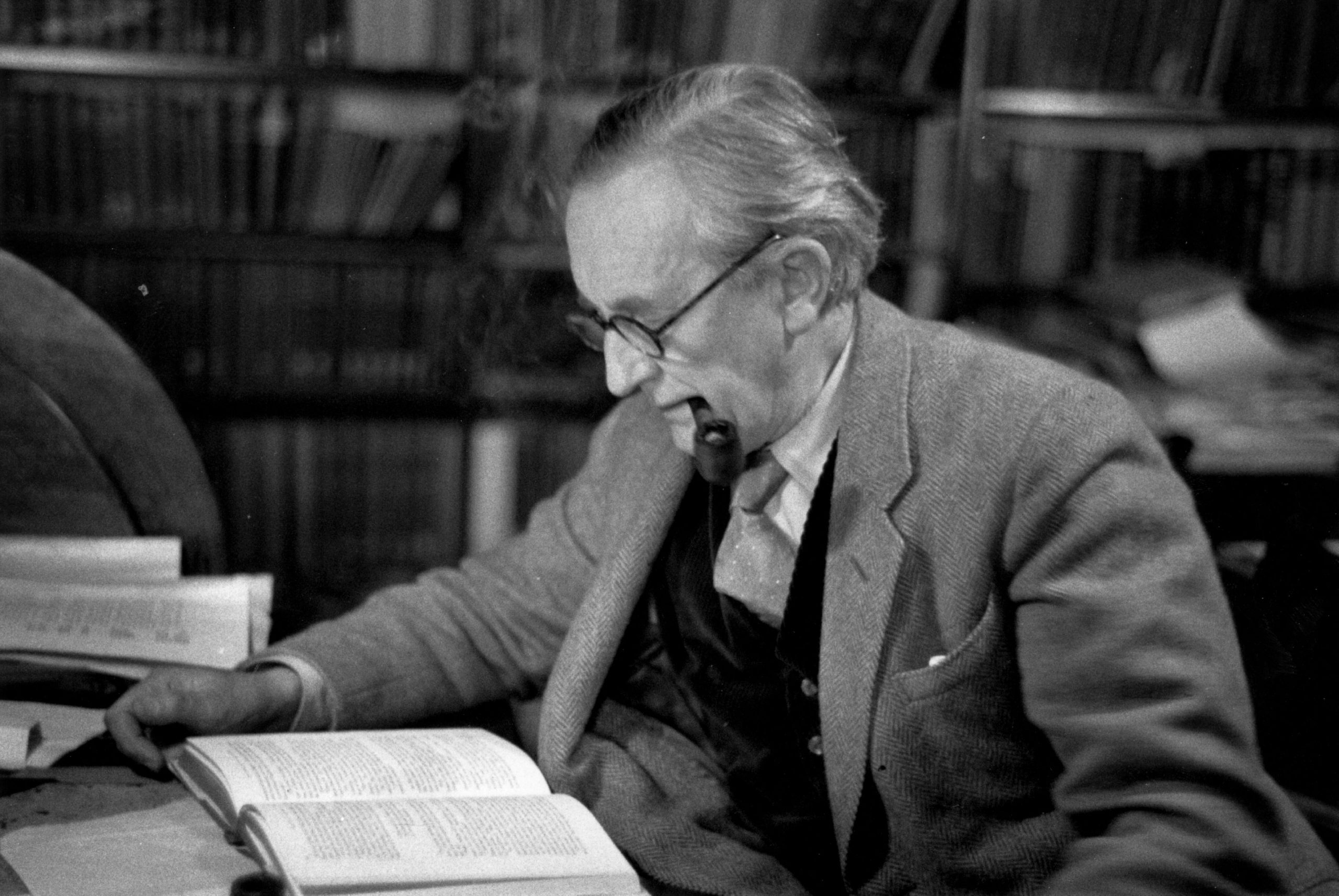
Tolkien in the Tar Heel State
Oscar Yuill reflects on why so many American Catholics are drawn to Tolkien, Chesterton, tweed waistcoats and the world of the English Catholic literary revival, despite its collapse in the country that produced it A friend recently invited my wife and me to North Carolina for a seminary-run BBQ, chock full of vibrant Catholic families and with the promise of succulent meats, home-grown tobacco and chortling allusions to that magnificent beast, the Chesterbelloc. Indeed, I have seldom met an American Catholic, at least of a certain age, who is not immersed in the works of the 20th-century British Catholic literary revival. Photographs from my friend’s wedding, in the same Carolinian town, show toddlers dressed, it seems, for Bilbo Baggins’s eleventy-first birthday. The groomsmen hold churchwarden pipes. And the best man resembles Chesterton to a degree scarcely believable. We had not so much been invited to North Carolina as to 1930s Oxford. Why should this be so? Why is the dominant traditionalist subculture in America so keen to ape the language, liturgical preferences and sartorial eccentricities of a revival that was, arguably, a complete failure? Only in 1852, at the first Provincial Synod of Westminster, had Newman declared: “Canterbury has gone its way. The Church in England has died, and the Church lives again. Westminster and Nottingham, Beverley and Hexham, Northampton and Shrewsbury, if the world lasts, shall become names as musical to the ear, as stirring to the heart, as the glories we have lost.” It seemed for a brief period that Hilaire Belloc, G.K. Chesterton, J.R.R. Tolkien, Gerard Manley Hopkins, Muriel Spark, David Jones, Eric Gill, Christopher Dawson, Ronald Knox, Arnold Lunn and countless others were the fulfilment of Newman’s optimism, inaugurating a new epoch of triumphal cultural Catholicism. (Such, indeed, was the fear among their cultural and moral competitors, such as the Bloomsbury Group.) “Arise,” Newman went on to say, quoting Solomon; “make haste, my love, my dove, my beautiful one, and come. For the winter is now past, and the rain is over and gone. The flowers have appeared in our land.” Bernard Shaw, Hilaire Belloc and G.K. Chesterton in 1927 Yet the flowers in this “Second Spring” were to be the lilacs and “dried tubers” of Eliot’s wasteland. Many of the buds were mown down in Flanders and Ypres and Passchendaele before they could bloom. No sooner had the Catholic Church been replanted in England than all Christendom leapt to the same assisted suicide. Surviving Catholics were forced to contend, in their poems and paintings and novels, with a disintegration of truth and meaning more total than Newman could have predicted, though certainly he detected its stirrings in the spectre of theological liberalism. Even at the level of technique – Evelyn Waugh was one of the first novelists to use the stilted language of “telephonese” – the works of the post-war generation often seemed forced into mirroring the fragmentation of a morally traumatised continent. When the 1960s rolled in, the vandalism extended even to the liturgies that had given them all their only anchor in the maelstrom. (Waugh et al.’s consternation with the Mass of Paul VI is well documented.) Vocations and church attendance cratered, only now showing signs of arrest. To the likes of Wilde, a Catholic conversion was a great, romantic thing, “the only religion to die in”. To Orwell, merely half a century later, commenting on Marchmain’s deathbed conversion in Waugh’s Brideshead: “One cannot really be Catholic and grown-up.” In which case, why grow up at all? Enter, then, the American mind. The average American, particularly in their jamboree-style politics, exudes an earnestness and sincerity that we in England often find perplexing. I am far from the first to make this observation, and I wonder if it has something to do with their lack of a deep “blood memory”: centuries of political and religious strife, culminating in the horrors of Hitler and Stalin, have created in Europe a collection of more or less jaded peoples. For example, patriotism in England or France or Germany may be derided, it may be ironic, it may be defensive. But the one thing it never is, and what in America it routinely is, is perfectly natural. Innocent. Dare I say child-like. I have a son of my own on the way and am looking forward to seeing the world afresh through his eyes. I know that, in four or five years, I have only to hand him a rotten stick covered in lichen and it shall become Excalibur. Children, of course, love belonging to clubs and gangs and posses. There is nothing that a child likes so much as to have a secret society and to make no secret of it. The same could be said of Americans and, in fact, that last sentence was a quote from Chesterton about Americans; I had only to substitute the word “child”. I should be clear. None of this is a comment on the intelligence of Americans. Chesterton himself thought them rather better educated than the average Englishman. I am suggesting, rather, that, for my Carolinian friend, enthusiasm for Tolkien & Co. – and dip pens and bitter ale and tweed waistcoats and churchwarden pipes – are effectively ways in which American Catholicism, much like the American Constitution, puts old wine into new wineskins. Much as the Celtic monks of Skellig Michael, at the outermost reaches of the world, were eventually to look back Romeward for their ecclesiological integrity, it was perhaps inevitable that American Catholics fell in love with a “style” of Catholicism rooted in the soil of the mother country. Wouldn’t you long for the Shire in a nation whose defining image, according to a recent meme, is the liminal space of the glowing Shell petrol station? In the end, my wife and I were compelled to stay put. We couldn’t afford the trip. She’s also 25 weeks pregnant. Add to that an elderly greyhound, for whom finding a dog-sitter is a nightmare. As good, jaded English folk, we know, of course, that Belloc’s cherished Sussex inns are shuttered, Tolkien’s beloved Midlands scoured and Chesterton’s fence torn up with insufficient reason. Tweed is reserved for the Mogg dynasty; pipes, for rosaceous pensioners quaffing their fifth Doom Bar of the morning on a Wetherspoons patio. The Catholic literary revival failed in England: England rejected it, ceding to paganism on the one hand and Islam on the other. Americans don’t have that legacy; to them, it was never a failure. Far away, in the touching sincerity of the American imagination, it all still exists, and can exist anywhere. Christ plays in ten thousand places, including in Gastonia, NC.
May 18, 2026