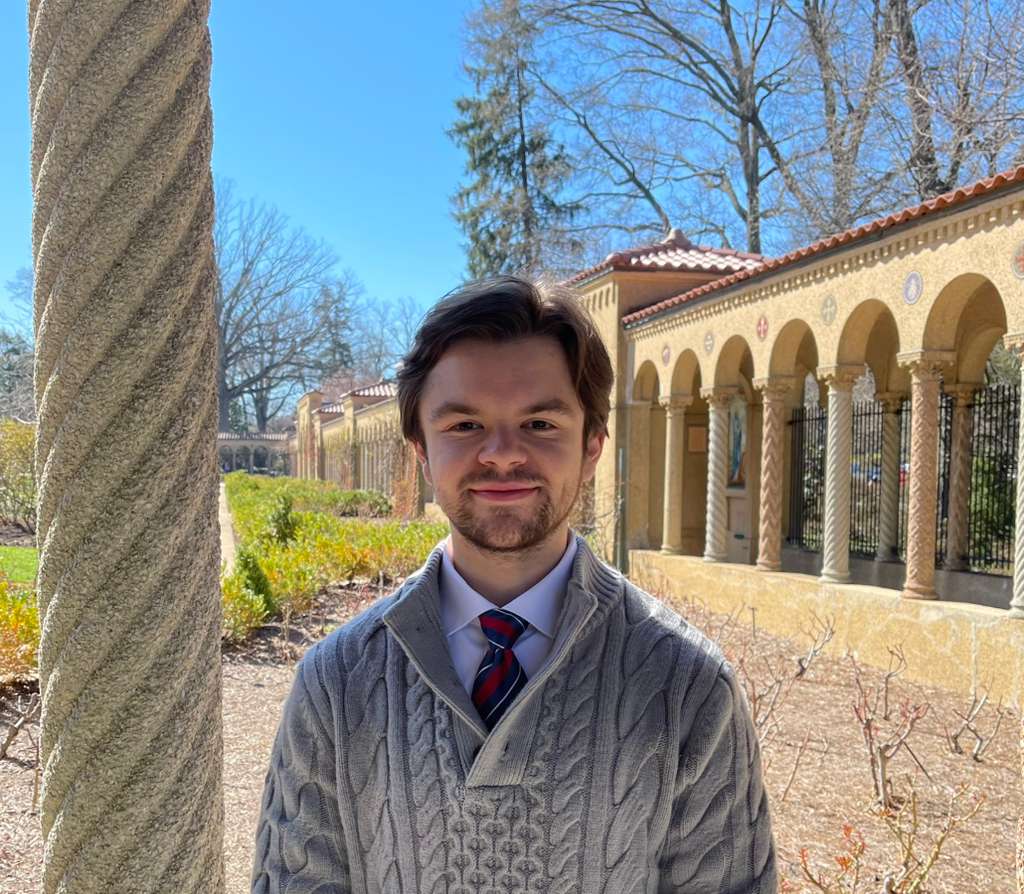
Introibo began with a problem. I wanted a single place to pray the Mass, the Office and the Rosary in Latin, and to follow the liturgical year as the Church has prayed it for centuries. I could not find exactly what I was looking for, so I built it myself. The reason I wanted those things, however, goes back much further.
I was raised Methodist, though “raised” is a generous word for what we actually did. We prayed at home sometimes. We almost never went to church. What I had instead of a churchgoing childhood was my grandmother’s house. She was Catholic, and her home was filled with statues of Our Lady, so I grew up without much religion but also without the anti-Catholic streak that a lot of Protestants pick up early. Mary was just there. In the corner of the living room, the way other people grow up with a piano nobody plays, Our Blessed Mother stood watching over us.
By the time I got to college, I would have called myself agnostic. I was not hostile towards Christianity; I was bored by it. I started seeing the bulletins around campus for Bible studies and St Mary’s Catholic Center and something called RCIA, and I would notice them and keep walking. I was a freshman in 2020, which meant my first year of college took place on a laptop on the desk in my bedroom. Like a lot of people that year, I felt hollowed out, and I started to wonder whether this was really all there was.
One afternoon I was low. Not depressed exactly, but close enough that the difference did not matter. I was at my desk. Then I prayed, just once, figuring it could not hurt. I cannot remember whether I said the words out loud or just in my head. I have struggled ever since to describe what happened next. The best I can say is that there had been a hole in my chest, or maybe in my soul, and it was filled almost instantly. What filled it was not physical, though I felt it in my body. It was a kind of warmth and presence and peace that I had not asked for. I do not want to oversell what happened. There was no vision and no voice and nothing dramatic about it. But it was real, and it was enough to make me want to know what had just happened to me.
For the next two years I read. I read about every religion I could find, beginning with the dead ones and working my way slowly inward towards the ones that were still alive, and from there through history and theology towards Christianity. I read the early Church Fathers. From Justin Martyr to Ignatius of Antioch and on through the rest of them, I saw something I had not expected. There was one Church, the same Church, that ran in an unbroken line from the Apostles down through the centuries and was still here. The Catholic Church was not a later development that had drifted from a purer original. It was the original.
I joined RCIA at St Mary’s Catholic Center in my senior year at Texas A&M. I told myself, and I meant it at the time, that I was only there to learn and that I was not going to convert under any circumstances, that I was there to find the holes in the story and walk away. Halfway through, I had to admit there were none. The objections I had carried in from a Protestant frame of mind, the Real Presence, praying to the saints, all of it, kept dissolving the more I read.
Aquinas helped me. The Fathers helped me more, and at some point I became the main obstacle. I had to admit that there is no faith without doubt, and that I was not going to know everything in this life with the certainty I wanted. I had to trust the Church. I had to trust the men and women who had been working through these questions for centuries before I was born, who were, frankly, wiser than I am. That kind of trust is humility, not a failure of reason.
RCIA usually takes a full year, but I was about to graduate and move to Washington for graduate school, so I completed both parts at once. I was received into the Church on Wednesday of the Sixth Week of Easter, 17 May 2023. That day is also a Minor Rogation Day, one of three the Church has set aside for centuries to fast and beg God for His mercy in the days before the Ascension. Rogare, in Latin, means to ask or to beg. It is perhaps providential that my journey, which started three years earlier with asking, should result in my being received into the Church on a Rogation Day.
For the first two years after my confirmation I went to the Novus Ordo and I was happy, because I was a Catholic and I was not looking for anything else. Then I went home to Florida to visit my mother and visited an FSSP chapel where the Traditional Latin Mass was offered. I did not like it the first time. I could not follow what was happening. I did not know when to stand or kneel. I felt as though I had wandered into someone else’s prayer by mistake, and I almost wrote the whole thing off as a bad experience.
I went back because I had heard too many people I respected speak about the old Mass with too much love for me to dismiss it after one visit. The second time it was different, and by the third time something had given way in me. What drew me in was the reverence, from the Gregorian chant to the incense, from kneeling at the rail to receive Our Lord to the prayers at the foot of the altar and the dozens of smaller prayers along the way that I had not even known existed. I came to love Low Mass especially. The long silences gave me room to be quiet before God, and to let Him be quiet in return.
Somewhere in those weeks I realised that the old Mass was the same discovery I had already made in my reading, only now I was making it on my knees. The continuity I had followed into the Church through Justin Martyr and Ignatius of Antioch was the same continuity I was kneeling within in that little chapel.
The Roman Rite as I was praying it is one of the oldest continuously prayed liturgies anywhere in the world, with a Canon whose words were already ancient when St Gregory the Great put his hand to them at the end of the sixth century. Almost every saint I had ever read about or loved had been formed by this Mass. My grandmother’s favourite, Padre Pio, offered it every morning of his priestly life, and offered it so slowly and so seriously that people travelled from across Europe to watch him. St Thérèse of Lisieux, whose Story of a Soul I had read more than once and whose Little Way had quietly reshaped the way I thought about holiness, had heard this Mass throughout her short life and had been sanctified within it. To kneel at the same rail and to hear the same Latin and to pray the same Canon they had prayed was to pray with them.
I started going every Sunday I could, and as I prayed I found that I wanted, more and more, to understand what I was actually praying. I wanted to follow the propers for the day. I wanted to know the feast and its rank and the season of the liturgical year. I wanted to learn the Latin, not as a performance and not to show anyone anything, but because the prayers themselves are old and beautiful and mean something exact that the English does not quite capture. What I wanted, in short, was one thing that put it all in one place: the Mass with the day’s propers, the Office, the Rosary in Latin, the texts side by side so that I could actually read what I was hearing. I looked. I could not quite find what I was looking for, so I built one for myself.
I called it Introibo, after the first word of the prayers at the foot of the altar. Introibo ad altare Dei. “I will go in to the altar of God.” I built it because St Carlo Acutis used what he had for the love of God, and I wanted to use what I had in the same way. I would have been content if no one else in the world had ever downloaded it, because it is the app I use every day. It opens each morning to the liturgical day itself, and from there to the Mass, the Office, the Rosary and the Stations of the Cross in Latin, an examination of conscience, a library of traditional prayers, a small school for learning ecclesiastical Latin through the prayers themselves, and the practices of the saints to follow throughout the year. It is free. It works fully offline. There are no adverts, no accounts and no tracking of any kind.
I had never built an app before this one. I am not a developer. My undergraduate degree from Texas A&M is in business and my master’s degree from Georgetown University is in finance, and the closest I had come was a few tools I had put together for work and school over the years, none of which had ever lived on anybody’s phone.
Three years on from my confirmation, the Catholic faith is the most important thing in my life and I do not know who or what I would be without it. Everything I want now comes from one thing, which is to serve God and to follow His will in whatever way He gives me to do it. The app is a small part of that, and the Mass is a far larger part, but all of it traces back, in the end, to the same small prayer I prayed by accident in my dorm room six years ago, when I did not know what I was doing, and it turned out not to matter, because Someone was already listening.