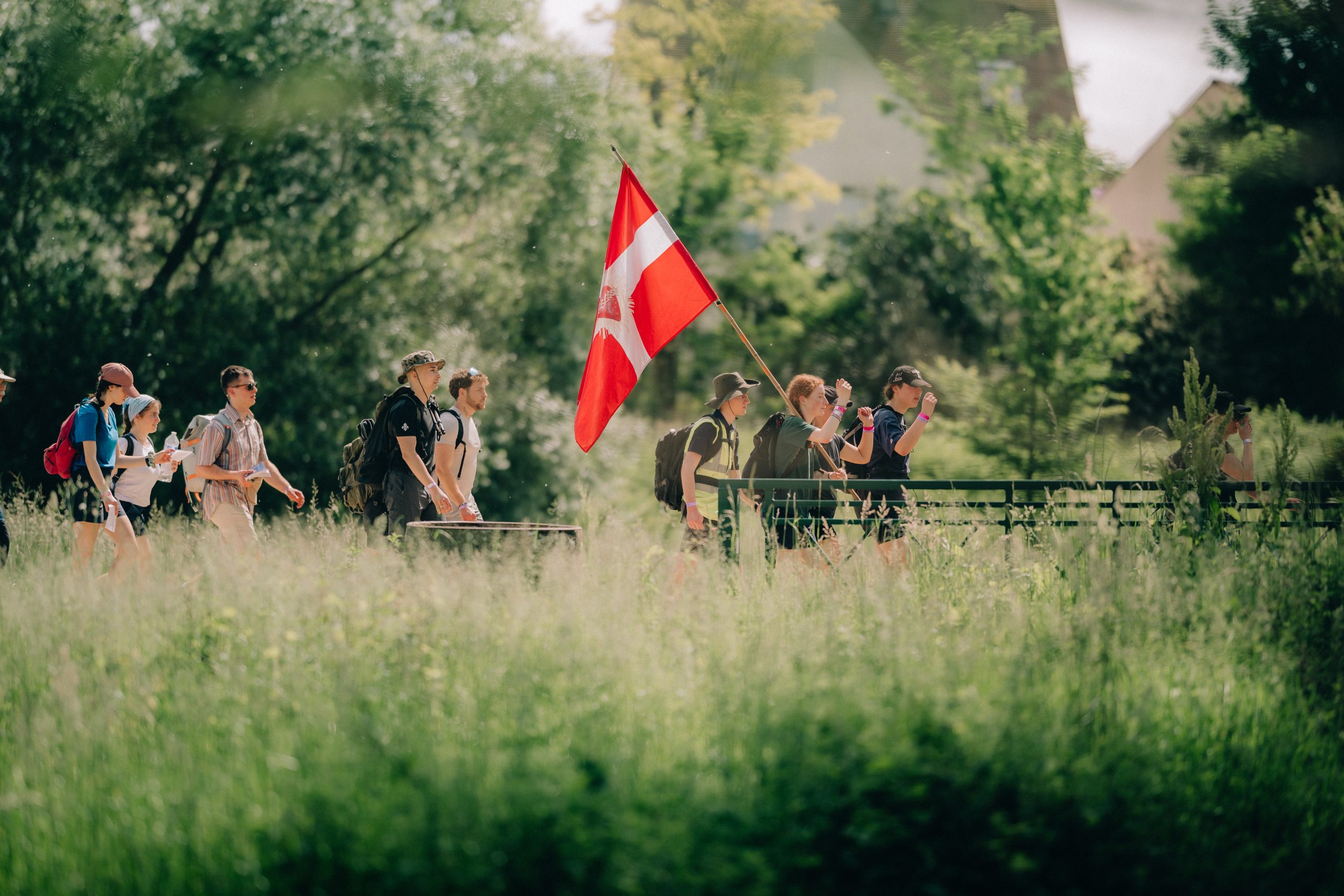
This year’s annual Notre-Dame de Chrétienté pilgrimage saw more than 20,000, mostly young people make their way from Paris to Chartres amid a Europe-wide heatwave. It is another record-breaking year for the event, which is supported by a further 6,000 volunteers.
Like much that is found in the traditional wing of the Church, the pilgrimage is both old and new. New in the sense that it has a vitality brought about by its young attendees. Old in the sense that its origins are medieval.
The city of Chartres owes its association with pilgrimage to the Sancta Camisa, a piece of silk worn by Our Lady during the Nativity. Depending on the account, Charlemagne either stole the relic in Constantinople, or was given it by the Byzantine imperial family, and then in turn gave it to his grandson Charles II, also known as Charles the Bald, who presented it to Chartres Cathedral in 876.
The Sancta Camisa came to prominence in 911, when Chartres was subjected to a Viking raid. Gantelme, the bishop and military leader of Chartres, is reported to have displayed the relic above the town gate. This is said to have emboldened the defenders of Chartres and terrified the pagan army, resulting in the town withstanding the attack. The episode led to the conversion of Rollo, the Viking leader, his pledge of allegiance to Charles the Simple, more charitably known as Charles III, and the establishment of the Duchy of Normandy, with Rollo as its first duke. Just over a century and a half later, that duchy would successfully invade England, a feat no one has yet matched.
Over the ensuing centuries, the cathedral was subjected to successive fires. After each one, however, the people of Chartres rebuilt it in ever more splendid forms. The “Cult of the Carts”, a medieval devotion in which lay people harnessed themselves to carts in place of oxen to transport building materials, finds one of its most famous examples in Chartres. In a letter written by Abbot Haymo of Saint-Pierre-sur-Dives to the monks of Tutbury Abbey in England, Haymo described people of all social classes dragging materials to Chartres catherdral as an act of piety and penance.
During the late Middle Ages and the Renaissance, Chartres became a major centre of Christian pilgrimage. Great fairs were held for the Presentation, the Annunciation, the Assumption and the Nativity, with pilgrims arriving in time to join the festivities. The area surrounding the cathedral functioned as a free-trade zone, exempt from state taxation and governed instead by cathedral authorities.
On 7 August 1773, the high altar designed by Charles-Antoine Bridan, depicting the Blessed Virgin Mary’s Assumption into Heaven, was consecrated. Today it remains one of the most iconic features of the medieval cathedral, alongside its celebrated stained-glass windows.
More than a century later, another Charles became synonymous with the cathedral. Charles Péguy, the French poet and essayist, helped keep the pilgrimage to Chartres alive by establishing the Paris route. Péguy spent much of his early life detached from religion and would probably have identified more as a Dreyfusard than anything else. Yet his growing nationalism ultimately led him back to France’s Catholic heritage, perhaps most clearly expressed in Le Mystère de la charité de Jeanne d’Arc (The Mystery of the Charity of Joan of Arc), first published in 1910.
In 1911, at the deathbed of his son Pierre, he made a promise that if his son recovered, he would make a pilgrimage to Chartres beginning in Paris. In 1912, he completed the journey, which left him transformed. He took his students on the pilgrimage and, when he was killed in battle in 1914, they continued the pilgrimage in his honour.
Péguy’s faith was complicated. He was married to a divorcee and was never able to be sacramentally reconciled with the Church. However, his Catholicism by conviction bears considerable witness to the power of the Church to draw people in, no matter the obstacles in their path.
Like many good traditions, Chartres fell out of use in the years of liturgical upheaval that followed the Second Vatican Council. The Paris to Chartres route, etched into Catholic intellectual France by Péguy, ceased to exist and it was not until 1982 that it resurfaced. It is now associated with the traditionalist movement within the Church. In 1988, after Archbishop Marcel Lefebvre was excommunicated following the illicit episcopal consecrations at Écône, a reality sadly familiar for this year’s pilgrimage, the Society of Saint Pius X began to walk the route in reverse, starting in Chartres and finishing in Paris, a journey it makes to this day.
Organised by Notre-Dame de Chrétienté, the pilgrimage has grown at a staggering rate. In 2010, attendance reached 10,000. By 2023, organisers had to close registration early and limit attendance to 16,000, with this year’s numbers exceeding 20,000.
This year’s journey started on Saturday 23 May, with Holy Mass at Saint-Sulpice, Paris’s second-largest church, where pilgrims gathered from 5 a.m., filling the surrounding streets. A military-style operation enabled pilgrims to drop off their tents and bags before being escorted through the Saturday morning streets of Paris.
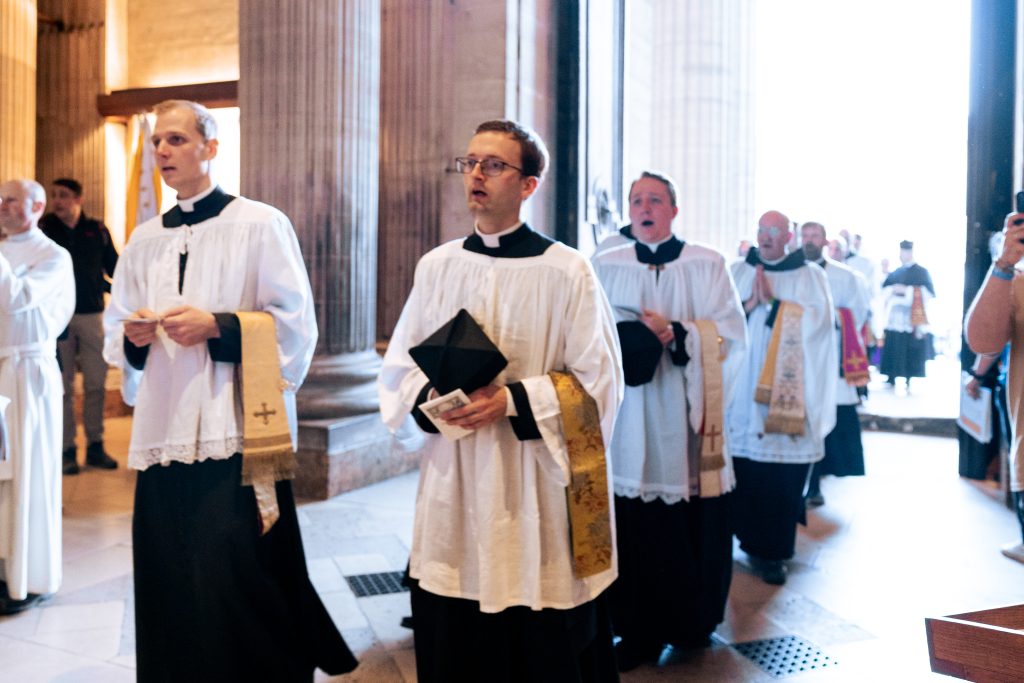
Walking through the streets of Paris, pilgrims sang hymns while carrying banners displaying saints to whom they are devoted. More than 4,000 religious and priests accompanied the groups, with the short distances between chapters providing opportunities for confession.
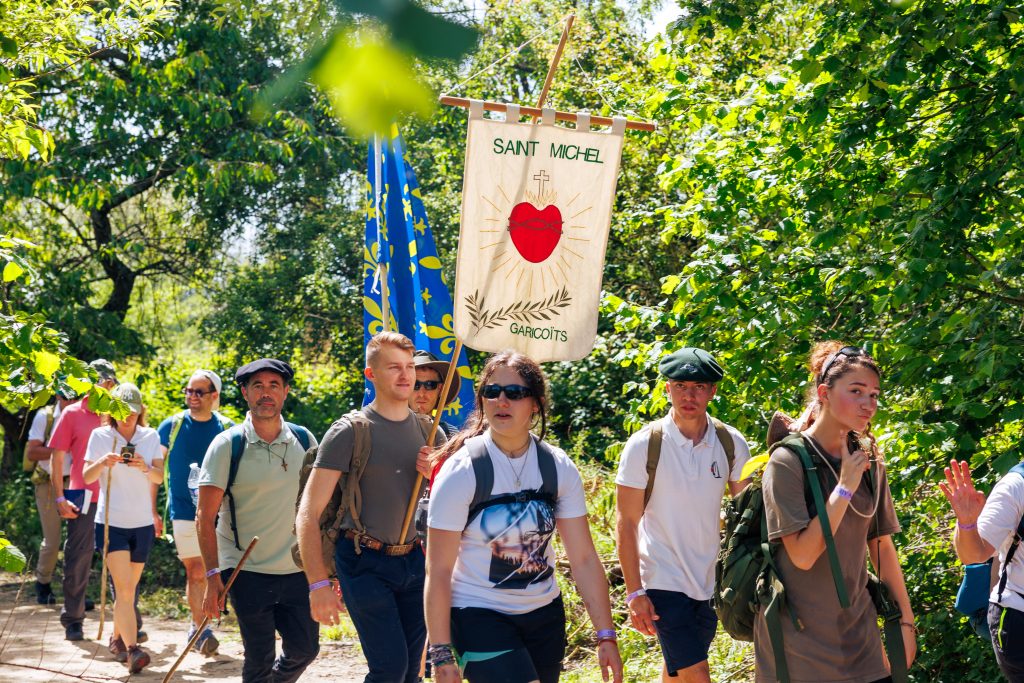
At the end of the first day, pilgrims camped at a vast campsite in Senlisse. Tents were erected for the night, with special areas for priests to celebrate individual Masses from 4 a.m. The following day, at 5.30 a.m., pilgrims were woken for what was potentially the most arduous day of the journey because of the heat and sun exposure, making their way to an open field en route for Pentecost Sunday Mass celebrated by Father Antonius Maria Mamsery, Superior General of the Missionaries of the Holy Cross, a community devoted to the Traditional Latin Mass. Speaking to AdVaticanum after Mass, Father Antonius described the pilgrimage as the “hope of Europe” and “the hope of the revival of the faith and of Catholicism as it once was”.
After another evening in a specially erected campsite, the final leg of the journey was completed on Pentecost Monday, a national holiday in France. The crowds arrived singing “Chartres sonne, Chartres t’appelle” (“Chartres rings, Chartres calls you”), before a Solemn Pontifical High Mass celebrated by Cardinal Raymond Burke.
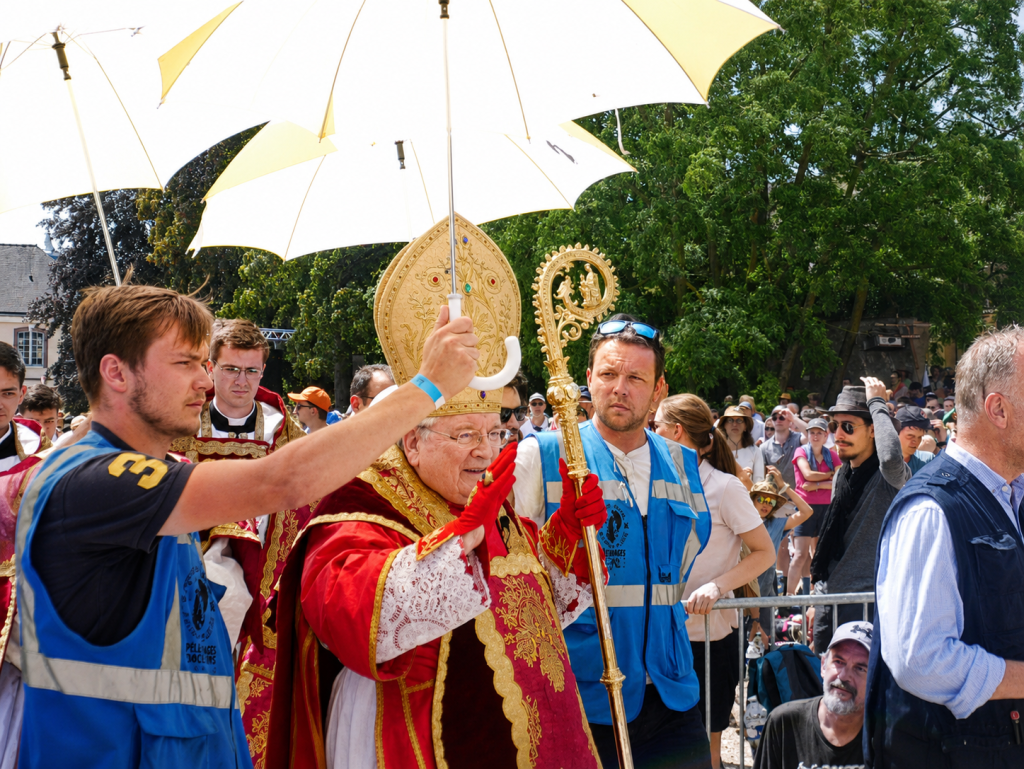
Today the pilgrimage has an international character, with pilgrims travelling from as far afield as Australia and South America. However, it remains predominantly French. France is currently experiencing a revival in Catholic devotion, with more than 13,000 adult baptisms this year, a 270 per cent increase in just five years, with the largest cohort, 42 per cent, aged between 18 and 26. The combined number of adult and adolescent baptisms exceeds 20,000, roughly equivalent to the number of pilgrims who took part in this year’s pilgrimage.
It is therefore no coincidence that this year’s pilgrimage theme is mission. Organisers said the event stands “at the heart of this spiritual awakening in France, for which prayers have been offered for 44 years”, and it was notable that passers-by were handed leaflets as the pilgrimage passed through towns and villages.
The Bishop of Chartres, Bishop Philippe Christory, who gladly welcomes the throngs of pilgrims to his cathedral each year, acknowledged that although the increase in baptisms is significant, “so many are still so far away from the Church”. Speaking to AdVaticanum, he said: “We have to love. Love is the key, the door and the way. Otherwise, this is all nonsense, if it is not for love of God and love for our brothers.”
A cynic might judge the turnout to be relatively small compared with the millions who gather for World Youth Day. But the pilgrimage exists without extensive promotion from the Church’s hierarchy, and it is a journey made entirely on foot. It is a pilgrimage of penance and mortification that requires a level of commitment and physical endurance beyond that of a typical pilgrimage. Perhaps a fairer comparison would be Rome’s annual marathon, which 22,000 people completed in 2025 in cooler weather and over less than half the distance.
What is increasingly clear is that Chartres represents a phenomenon that it is now impossible for the Church hierarchy to ignore: a younger generation of Catholics is devoted to the Traditional Latin Mass in substantial numbers, and that this devotion will persevere through any restrictions imposed upon it. The first signs of this acknowledgement are becoming apparent, notably in Pope Leo’s request earlier this year that the French bishops show charity towards those attached to the traditional form of the Mass. Brother João, a member of the Fraternity of St Joseph the Guardian, a community that offers the Traditional Latin Mass in the Diocese of Fréjus-Toulon to re-evangelise France, put it succinctly when he told AdVaticanum: “Chartres is a testimony.”
With a younger generation of clergy also rising through the Church’s hierarchical ranks who share the same devotion, it remains only a question of time before that testimony leads to concrete action and the promotion, rather than the penalisation, of the Church’s most ancient and edifying liturgical expression.
Photo credit: Notre-Dame de Chrétienté