The Society of St Pius X has issued a forceful response to Cardinal Fernández’s warning that planned episcopal consecrations without papal approval would constitute “a schismatic act”, arguing that the Society is acting out of necessity for the “salvation of souls” and therefore incurs no automatic excommunication under canon law.
The response was published on 15 May by the Society’s official in-house news service, through Fr Jean-Michel Gleize, the French professor at the seminary at Écône who took part in doctrinal discussions with Rome between 2009 and 2011.
The intervention follows a statement issued two days earlier by Cardinal Víctor Manuel Fernández, prefect of the Dicastery for the Doctrine of the Faith, who warned that the episcopal consecrations announced by the SSPX “do not have the corresponding pontifical mandate”.
Cardinal Fernández said: “This gesture will constitute ‘a schismatic act’ (John Paul II, Ecclesia Dei, n. 3), and ‘formal adherence to the schism constitutes a grave offense against God and entails the excommunication established by Church law’.”
The cardinal added that the Holy Father was praying that the Society’s leaders would “retrace their steps regarding the very serious decision they have taken”.
Fr Gleize’s reply interpreted the Vatican declaration as confirmation that Pope Leo XIV will refuse to grant authorisation for the consecrations expected to take place on July 1.
“The novelty that appears in this declaration from Rome,” Fr Gleize wrote, “is that the episcopal consecrations scheduled for July 1st will not be ‘accompanied by the corresponding papal mandate’. Coming from a Prefect of a Vatican dicastery, this remark is quite clearly an attempt to convey to the Society that Pope Leo XIV will refuse to authorise the consecrations.”
Fr Gleize based much of his argument on Canons 1323 and 1324 of the 1983 Code of Canon Law, maintaining that a person acting out of necessity, or under the sincere belief that such necessity exists, is not subject to automatic penalties. Quoting canon law directly, Fr Gleize argued that a person who violates a law “out of necessity, or to avoid serious harm, is not punishable by any penalty”, provided the act is not “intrinsically evil or causes harm to souls”.
He further contended that even if Church authorities judged the act objectively wrong, “the penalty of latae sententiae is not incurred” where the accused acted in good faith under a perceived necessity. “In other words,” Fr Gleize wrote, “even if one admits that there is no real necessity to justify the act, the mere fact that the perpetrator committed the act driven by what he believed to be a real necessity is sufficient to excuse him from the crime.”
The SSPX professor insisted that the Society’s intention remained the good of the Church rather than rebellion against papal authority. “This is why it disregards this application of ecclesiastical law that would accuse it of a crime and impose the corresponding penalty,” Fr Gleize stated. “Why? Simply because ecclesiastical law cannot be applied to the detriment of the salvation of souls.”
Fr Gleize added: “In all reality, there is no wrongdoing, no schism on the part of the Fraternity. But only the same zeal which remains unchanged, even if it takes on paradoxical forms in the eyes of the world, for the glory of God and the salvation of souls.”
The response concluded with an unusually confrontational passage directed at senior churchmen associated with more progressive currents in the Church. “Excommunicated? But by whom?” Fr Gleize asked. “By those who receive the blessing of a schismatic woman, the Archbishop of Canterbury, Sarah Mullally? By those who authorise the blessing of Fiducia Supplicans? And who kneel before Pachamama?”
Cardinal Fernández’s statement had drawn immediate comparisons with events preceding the 1988 consecrations carried out by Archbishop Marcel Lefebvre at Écône without papal mandate. Shortly before those consecrations, Cardinal Bernardin Gantin, then prefect of the Congregation for Bishops, issued a formal canonical warning to Archbishop Lefebvre declaring that such an act would incur automatic excommunication.
“Since on June 15, 1988 you stated that you intended to ordain four priests to the episcopate without having obtained the mandate of the Supreme Pontiff,” Cardinal Gantin wrote, “I myself convey to you this public canonical warning.” His Eminence added: “If you should carry out your intention as stated above, you yourself and also the bishops ordained by you shall incur ipso facto excommunication latae sententiae reserved to the Apostolic See.”
Archbishop Lefebvre nevertheless proceeded with the consecrations on June 30, 1988, leading Pope St John Paul II to issue the motu proprio Ecclesia Dei, which described the act as schismatic. The SSPX has long disputed that interpretation, insisting that Archbishop Lefebvre acted in a state of necessity amid what the Society viewed as a profound doctrinal and liturgical crisis in the Church following the Second Vatican Council.
The latest public exchange between Cardinal Fernández and Fr Gleize now appears to indicate that tensions between Rome and the Society are entering a new and potentially decisive phase ahead of the proposed July consecrations.
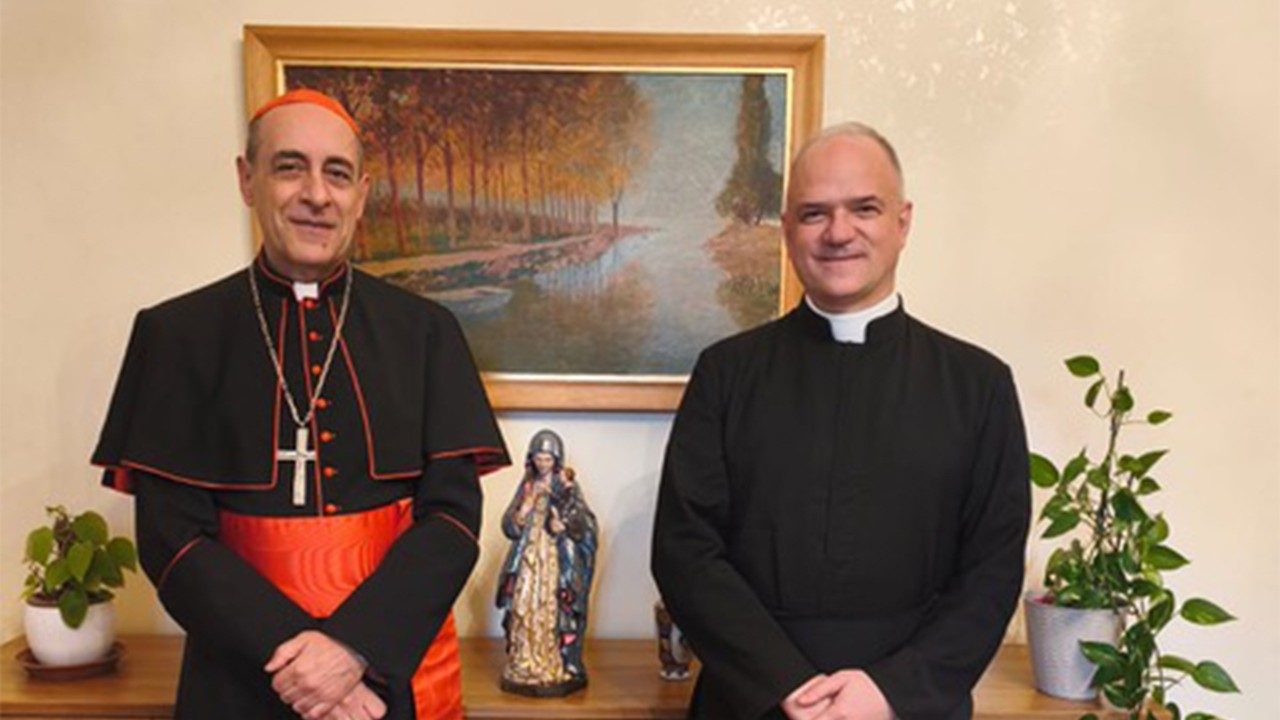
Photo credit: Dicastery for the Doctrine of the Faith