In a quiet office in Rome, far from the crowds that gather in St Peter’s Square below, the Church’s understanding of holiness is subjected to some of its most exacting tests. Here, within the Dicastery for the Causes of Saints, reputations are sifted and claims of miracles scrutinised with a care and precision that belie the recent perception of swift modern canonisations.
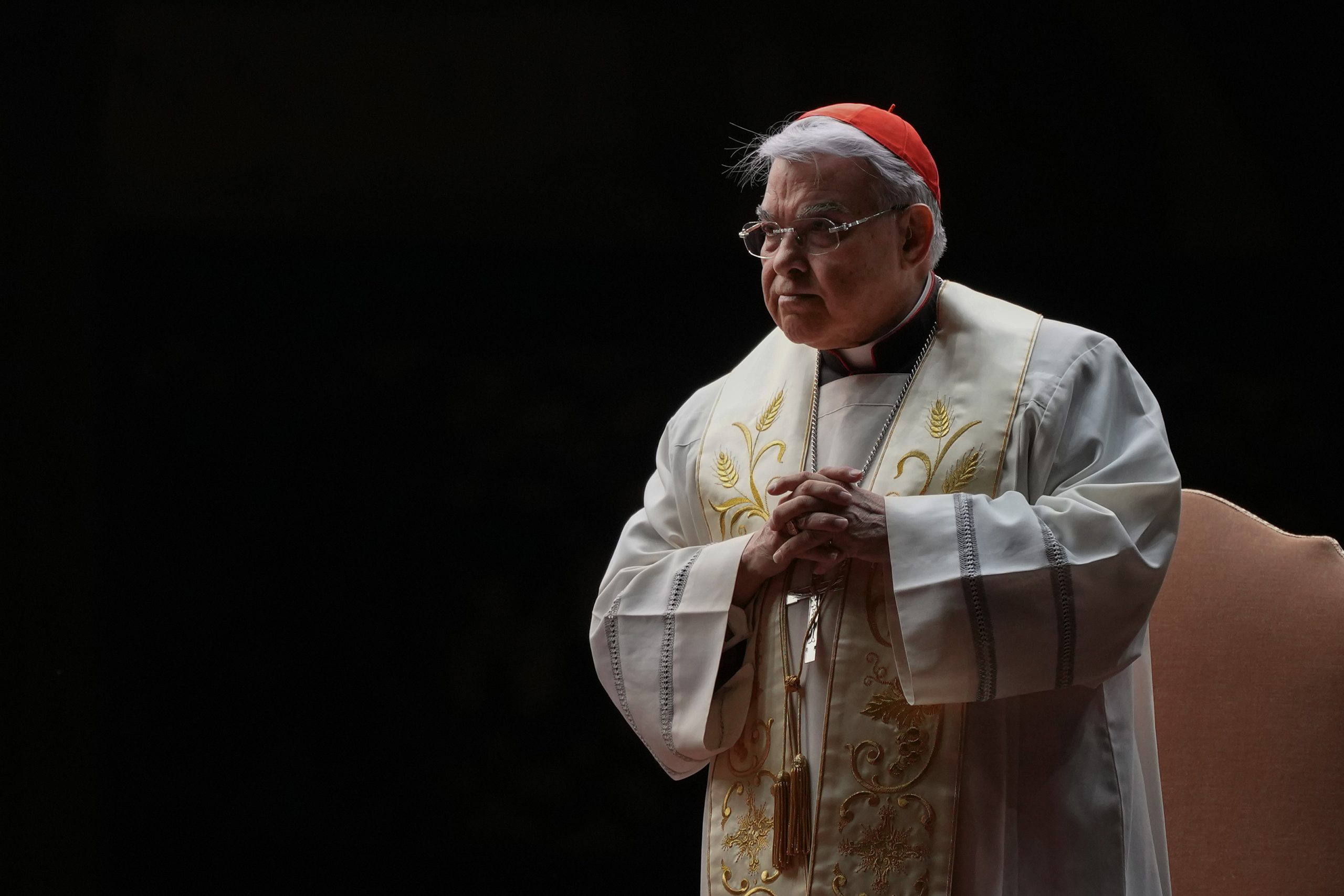
The prefect in charge, Cardinal Marcello Semeraro, soft spoken and clearly at ease with the weight of his responsibilities, has spent years at the centre of this process. Though prefect only since 2020, he brings with him more than a decade as a member of the dicastery.
The cardinal is keen to stress the deep historical roots of his work. The procedures stretch back centuries, shaped significantly by reforms following the Council of Trent and later refined under Pope Paul VI and Pope John Paul II.
Cardinal Semeraro described the most recent reforms of the procedures as “in the very last phase”, explaining that there was a need to streamline a process “that had become very problematic, very complicated, very complex”. He presented this streamlining not as a lowering of standards but as a practical correction to a system that had grown excessively burdensome, while insisting that the core nature of the work remains unchanged: “a long procedure in which one goes in search of the truth”.
Earlier centuries placed heavy emphasis on miracles, as well as on widespread popular devotion. Over time, however, the Church shifted its focus. Today, the decisive criterion is what the cardinal called “heroic virtue”, a life lived in a way that stands out, not as theatrical heroism, but as a sustained and exemplary fidelity to the Christian life.
“‘Heroic’ can be misunderstood,” he noted. “It simply means something beyond the ordinary. Something worthy of imitation.”
The cardinal explained that before the Council of Trent the evaluation of sanctity rested above all on “the abundance of miracles” and widespread popular recognition, but after Trent the focus moved decisively to “the presence of a Christian life verified through the virtues, the theological virtues and the cardinal virtues”. Even though the miracle requirement and the esteem of the people of God remain necessary, the real work of the dicastery now centres on verifying this heroic virtue, a life that is “outside the ordinary, that is, a bit more than the others, in such a way that it can be imitated”.
One of the most common criticisms of the modern canonisation process is that it has become too fast. The relatively swift canonisations of figures such as Pope St John Paul II or of younger figures like Carlo Acutis have fuelled this perception.
The cardinal rejects the idea that speed has replaced rigour. The five year waiting period after death – it used to be 50 years, as laid out by Urban VIII in the 17th century, but was reduced after the Second Vatican Council – is not, he insists, about haste but about preserving evidence. “If we wait too long, witnesses die and memory fades. The process depends on living testimony.”
On the much criticised shortening of the waiting period, Cardinal Semeraro was emphatic: historically it was necessary that “50 years had passed from death to begin the process”, but today “to begin the process it is required that the person has been dead at least five years”.
Far from being rushed, the cardinal insists, many causes take decades. And while the formal office of the “devil’s advocate”, a Vatican official formerly mandated to argue against a candidate’s cause, has been abolished, its function has not disappeared. Instead, it has been expanded.
“Today,” he explained, “we have entire commissions of historians and theologians whose task is precisely to test, to challenge, to falsify.” If even a single serious doubt emerges, the process halts until it can be resolved.
If heroic virtue forms one path to sainthood, martyrdom remains its most ancient and, in many ways, most revered form. “The first saints were martyrs,” the cardinal said. “And in a sense, all sanctity is a participation in martyrdom.”
Yet even here, the Church proceeds cautiously. Martyrdom, in its strict sense, requires death inflicted out of hatred for the faith: odium fidei. But modern cases are often more complex.
Take Óscar Romero, whose assassination in 1980 raised questions about whether he died for political or religious reasons. The cardinal acknowledged the difficulty: “Often the motivations are mixed. But if the Christian witness is essential to the act, then martyrdom can be recognised.”
His Eminence insisted on the classical, strict understanding of martyrdom: “We use the word martyrdom in the strictest, classical sense, where life is taken for a motive of the faith or strictly linked to the faith, because he is a Christian.”
He gave concrete examples, the Ulma family in Poland, killed for sheltering Jews, and the Sicilian judge Rosario Livatino, killed because his Christian integrity made him incorruptible, to illustrate that even when the immediate trigger is not an explicit demand to renounce the faith, the act must still be “linked to the faith”. Anything less does not qualify.
At the same time, the Church has developed new categories. Under Pope Francis, the notion of the offering of life, where a person freely gives their life for others without being killed explicitly for the faith, has been formally recognised. It reflects a broader attempt to capture the realities of modern witness.
One of the more delicate issues for the dicastery is the status of non Catholic martyrs. Figures such as Dietrich Bonhoeffer are widely regarded as witnesses to Christ, yet cannot be canonised in the Catholic Church.
“The Church recognises holiness outside her visible boundaries,” the cardinal said carefully. “But canonisation is an act for her own faithful. It is not within her competence to declare saints for other communities.”
Nevertheless, there have been gestures towards broader recognition. Initiatives begun during the Great Jubilee of 2000 and renewed under Pope Francis have commemorated “new martyrs” from across Christian traditions. It remains, however, an acknowledgment rather than a formal declaration.
If martyrdom is one path to sainthood, miracles remain another essential requirement, particularly for beatification and canonisation outside martyrdom cases.
Here, the dicastery’s methods are strikingly empirical. Claims must be supported by rigorous medical documentation and are examined by panels of specialists, often seven or more doctors, whose task is not to prove divine intervention but to exclude any natural explanation.
“The doctors must say only this,” the cardinal explained: “that, according to current medical knowledge, there is no explanation.”
Advances in science have, if anything, made the process more demanding. Conditions once considered incurable may now have treatments, raising the bar for what counts as miraculous. Cases are debated intensely; some discussions, he noted, can last hours.
What happens when troubling information emerges about a candidate for sainthood? The answer, again, is caution.
Every cause undergoes exhaustive historical scrutiny. If credible doubts arise, whether about moral conduct or factual claims, the process is suspended. “Not cancelled,” the cardinal emphasised, “but stopped until clarity is reached.”
Even after canonisation, the Church does not reverse its decisions. But the cardinal insisted that the thoroughness of the process makes serious errors exceedingly unlikely.
The conversation turned to politics and whether someone with controversial political views could be canonised.
Here, the cardinal distinguishes between political positions and ideologies. While the former do not in themselves exclude a candidate, ideologies fundamentally opposed to Christianity pose a deeper problem.
“The question is always the person,” he said. “Their life, their conversion, their witness.” When asked if his dicastery would ever canonise a fascist, for example, the cardinal shook his head.
Cardinal Semeraro replied that such a cause “can be technically excluded from the canonisation process”. He explained that Nazism and Fascism are not ordinary political parties but “an ideology, not a party”.
For Cardinal Semeraro, ideologies such as Nazism, Fascism and Communism “are now considered de facto anti Christian”. Therefore, belonging to an ideology fundamentally opposed to Christianity constitutes a genuine obstacle to the recognition of heroic virtue.
Looking ahead, Cardinal Semeraro has a strong sense of the kind of men and women he would like to see canonised. “What we need today,” he said, “are not figures who simply comfort us, but figures who make people ask: why do they live like this?” With more than 1,500 causes under examination, including some dating from the 15th century, the cardinal will have plenty to choose from.