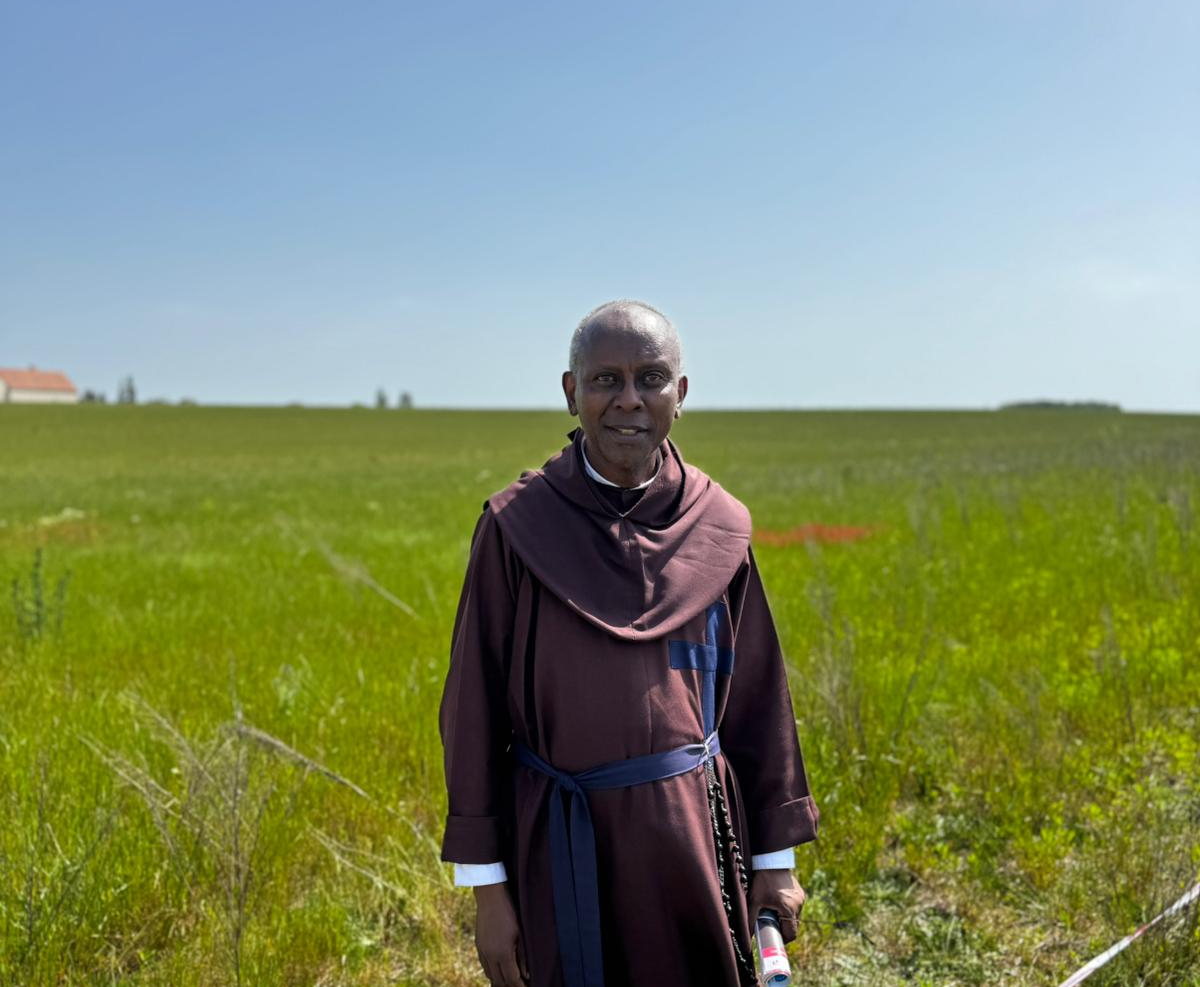
This year’s annual Pèlerinage de Chrétienté saw more than 20,000 people walk from Paris to the medieval cathedral city of Chartres. On Sunday, the pilgrims arrived in a field just outside Rambouillet, Yvelines, for Pentecost Sunday Solemn High Mass.
The celebrant was Father Antonius Maria Mamsery, a Tanzanian priest and Superior General of the Missionaries of the Holy Cross (MSC). Chief celebrant of the 2023 Summorum Pontificum pilgrimage, Fr Antonius is well known for his attachment to the Tridentine Mass. Indeed, his community’s charism is to offer the traditional Mass, particularly in parts of the world where it is not readily available.
After Holy Mass, Fr Antonius was kind enough to sit down with AdVaticanum and share his thoughts on the Church in Africa and Europe, the Traditional Latin Mass, and his impressions of the Pèlerinage de Chrétienté, which he was attending for the first time.
AV: Father Antonio, could you share the story of your vocation to the priesthood and how you came to be superior of your community?
AM: My vocation began when I was very young. My parents used to tell me that when I was around eight years old I was already teaching my brothers how to say Dominus Vobiscum, and sometimes I would cut up apples and distribute them to them like Communion.
Later, I entered a minor seminary in the Kilimanjaro region of Tanzania. Then I discovered the beginnings of my congregation and moved from the seminary into the congregation in 1985. I joined this congregation then and have remained in it until now.
My community was received by Saint John Paul II as one of the Ecclesia Dei communities from the beginning of the department’s establishment in 1988. We are one of those groups that preserved tradition without any negativity towards the Church.
AV: As a native Tanzanian priest, what have you observed about the growth of the Traditional Latin Mass and the future of the Church in Africa?
AM: When the liturgical changes were introduced, the natives were very obedient. They obeyed the hierarchy, but they still had this nostalgia. They were still searching for something. So, when we present to them the traditional liturgy, they sometimes have this very touching expression: “Oh, the Mass returned!”
It is wonderful. They knew something was lost because they were faithful to the tradition.
In Africa, devotion to the traditional Mass is growing. People are searching for it in countries like Uganda, Tanzania and parts of North Africa. Now I receive calls from young people from Mozambique, Angola and South Africa who want to know the traditional Mass.
I have visited some of these groups and they are very enthusiastic. They want to know more about it.
AV: The media has often reported that the Church in Africa is experiencing significant growth, while the Church in Europe is in a state of decline. Do you think this accurately represents the state of the Church?
AM: I think that is quite accurate. But for me, Chartres has been very impressive. There are so many children here and I had never seen such a large group of children and young people in Europe. When you go to church, normally there are people from everywhere, in Germany, in Italy, in England, where I have visited, but in the traditional communities there are many young people.
Traditional families are numerous, so they can be the future of the countries in Europe.
AV: Do you think there will be a future when Africa, especially in the form of priests, will be the continent to re-evangelise Europe?
AM: Yes. There are many vocations in Africa and there are many major seminaries. In my country, we had three major seminaries, but now there are at least seven and they are completely full. The numbers range from 300 to 400 in the major seminaries.
If many of them are ordained, they can be sent to re-evangelise or help bishops who do not have vocations in their dioceses.
In some parts of Europe there are dioceses that have only one seminarian or two, and they will need priests. There are men in Africa and Asia who are being formed for the priesthood and will be able to help others.
Yesterday evening I was speaking with someone who told me that here in France a large number of diocesan priests are from Africa because the lack of priests in Europe is now very great.
AV: In your homeland, there are a large number of communities where Catholics and Muslims live alongside one another. How does the Church interact with followers of Islam living amongst them?
AM: Many Muslims are converting to Christianity. For example, during this Easter season many have been baptised. They come for catechism, they bring their children and they come to our schools.
In Zanzibar, which is predominantly Muslim, we have various schools and many of those who register are Muslim families who learn about the Christian religion peacefully.
There are not the fanatics that can sometimes be found in North Africa, where there are conflicts.
In Tanzania there is peace between the two religions. We are friendly, we share our cultures and many other things.
AV: What is your impression of this Pentecost pilgrimage to Chartres and the movement around it?
AM: Well, this is my first time in Chartres. It is the hope of Europe, the hope of Christian culture, the hope of the revival of the faith and of Catholicism as it once was.
The people are making sacrifices, walking in peace, praying and singing. The priests are hearing confessions, blessing people and offering guidance.
You would not expect this in our time. You would expect people to be busy with their phones or television. But now they have left their homes to walk this hundred-kilometre pilgrimage. This is a revival of the faith. That is wonderful.
AV: One of the characteristics of Chartres is the respect and devotion shown to priests. Why do you think this is?
AM: Catholics and society itself respect priests when they live as priests. If priests in some way abandon themselves, so will be the response.
But these priests of the traditional groups are trying their best to live their priesthood well. That is why people are so open to them. Young people see them and discover they have a vocation as well. They see the priest and think: “I want to be like that.”
Young families will look and say: “How can my son become like that priest?” They often come from large Catholic families and their parents want them to be open to becoming a priest.
AV: And finally, Father, how can people support your mission?
AM: My community is growing rapidly. We have a great need for more space. I have started a minor seminary for early vocations. Initially we only had 17 young people, so I thought perhaps I had to offer a structure that could support up to 50, and suddenly we had 300.
We need support so that we can provide the boys with board, classes and more.
When they finish high school, we now have to offer them the opportunity to continue their philosophy and theology studies at a major seminary. So, if there are good people who want to help so that we have the possibility to grow, we will be very grateful.
One of our men was recently ordained a priest in the Philippines and we had many young men saying: “Can I come? Can I come?” So we need the means to expand.