

Katholikentag
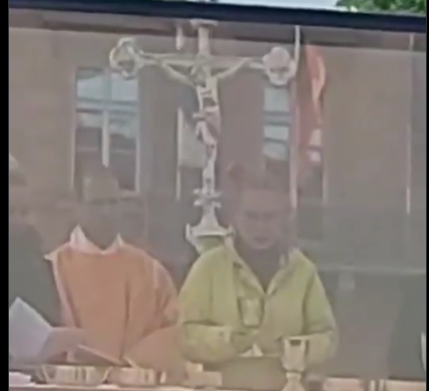
Woman appears to recite words of consecration at German Catholic congress
More than 70,000 people attended the 104th German Katholikentag in Würzburg as controversy over liturgical practices and the future direction of the Church in Germany again overshadowed the country’s flagship Catholic lay assembly. Footage circulated online during the event appeared to show a woman holding a chalice and reciting the words of consecration while a […] More than 70,000 people attended the 104th German Katholikentag in Würzburg as controversy over liturgical practices and the future direction of the Church in Germany again overshadowed the country’s flagship Catholic lay assembly. Footage circulated online during the event appeared to show a woman holding a chalice and reciting the words of consecration while a priest stood behind her. If the footage is as alleged, it would constitute a grave liturgical abuse and could not effect the consecration of the Eucharist. The Church has always taught that only a validly ordained priest acts in persona Christi during the Holy Sacrifice of the Mass. The Council of Trent and Tradition affirm that the minister of the Eucharist must be a priest: “No one can perform this sacrament except the priest duly ordained.” Canon 900 §1 of the 1983 Code of Canon Law states clearly: “The minister of the Eucharistic celebration is a validly ordained priest alone.” A laywoman, even one reciting the proper words with apparent intention, lacks the sacerdotal character imprinted by Holy Orders. Attempts by women or lay people to “co-consecrate” have been consistently condemned as invalid and sacrilegious, regardless of the presence of a priest. The priest’s passive stance does not supply what is lacking in the woman’s orders; rather, it implicates him in the abuse. It profanes the Most Holy Sacrament and wounds the faithful. This alleged incident is symptomatic of the ongoing crisis of liturgical experimentation and rejection of apostolic Tradition in parts of Germany. The Church’s doctrine on the male-only priesthood is de fide , rooted in the example of Christ, who chose only men as Apostles, the constant practice of the Apostles and their successors, and infallible teaching. A woman cannot validly consecrate the host under any circumstances; any “host” she handled remained mere bread and wine. The faithful present were not receiving the Body and Blood of Christ from her actions. The four-day gathering, organised by the Central Committee of German Catholics (ZdK), was held under the theme “Courage, Let Us Rise!”, and combined liturgical celebrations, political discussions, cultural events and debates about the future of the Church. Irme Stetter-Karp, president of the ZdK, said in her closing remarks that the Katholikentag had been marked by “commitment and solidarity, which instilled courage”. Marc Frings, general secretary of the ZdK, described the gathering as “a broadly based Catholic Congress” and defended the inclusion of groups and speakers from outside the Church’s traditional structures. “We gave secular partners with shared values a platform and space along the Church Mile,” he said. “We also offered participation to those with whom we might have little overlap within the Church. This doesn’t make us arbitrary, but rather open to dialogue.” Frings said the event’s motto had shaped discussions throughout the week “on our panels, in the workshops, in conversations along the Church Mile, and in the many spiritual offerings”. He also highlighted several cultural events connected to the gathering, including Susanne Wagner’s installation Schmerzpunkt , dealing with abuse and cover-ups in the Church, a performance on the Middle East conflict involving Emanuella Amichai, Mohammad Kundos and Bernhard Stengele, and a large mural by the Berlin art collective innerfields titled Our Big Picture of the Future . Bishop Heiner Wilmer, president of the German Bishops’ Conference, said the gathering had demonstrated unity within the German Church despite differing views. “Würzburg has shown that we are on a shared journey, each and every one of us contributing our own charism,” he said. “The bridges over the Main River are symbolic of our ecclesial path. We must build bridges to reach others.” “That is why it is good that this Catholic Congress made strong political statements and an unequivocal commitment to democracy,” he added. “We as a Church will continue to protect the freedom and democracy we have won on a foundation of Christian values, against all slogans that promise us otherwise.” The Bishop of Würzburg, Bishop Franz Jung, said the atmosphere throughout the event had encouraged dialogue between Church representatives and political leaders. “In the events with representatives of political life, I consistently sensed mutual respect and, above all, a genuine interest in engaging in dialogue,” he said. “Given the constant calls today to strengthen democracy, I am convinced that this Catholic Congress provided a very valuable platform for bringing people together for constructive dialogue on this topic.” Jung also welcomed the participation of Dr Josef Schuster, president of the Central Council of Jews in Germany, during one of the major liturgical celebrations. “I am very grateful to Dr Josef Schuster and all those involved that we were able to send such strong signals of interreligious unity during these days,” he said. Organisers said about 34,000 visitors bought tickets for the Katholikentag , while around 40,000 others attended open events and visited the “Church Mile” exhibitions across the city. Roland Vilsmaier, the managing director of the event, said nearly 700 local hosts had provided around 2,500 overnight stays for pilgrims and visitors. The Katholikentag traces its origins to 1848, when the first gathering, then called the General Assembly of the Catholic Associations of Germany, took place in Mainz amid political unrest across Europe. It was organised by the Pius Society for Religious Freedom and later came under the direction of the ZdK. The assemblies continued during Otto von Bismarck’s Kulturkampf in the nineteenth century, though they ceased during the First World War and under the Nazi regime. In the decades after the Second Vatican Council, the Katholikentag became increasingly associated with progressive movements within German Catholicism. In 1968, members linked to the movement were among those who publicly dissented from Humanae Vitae , Pope Paul VI’s encyclical reaffirming the Church’s opposition to artificial contraception.
May 19, 2026