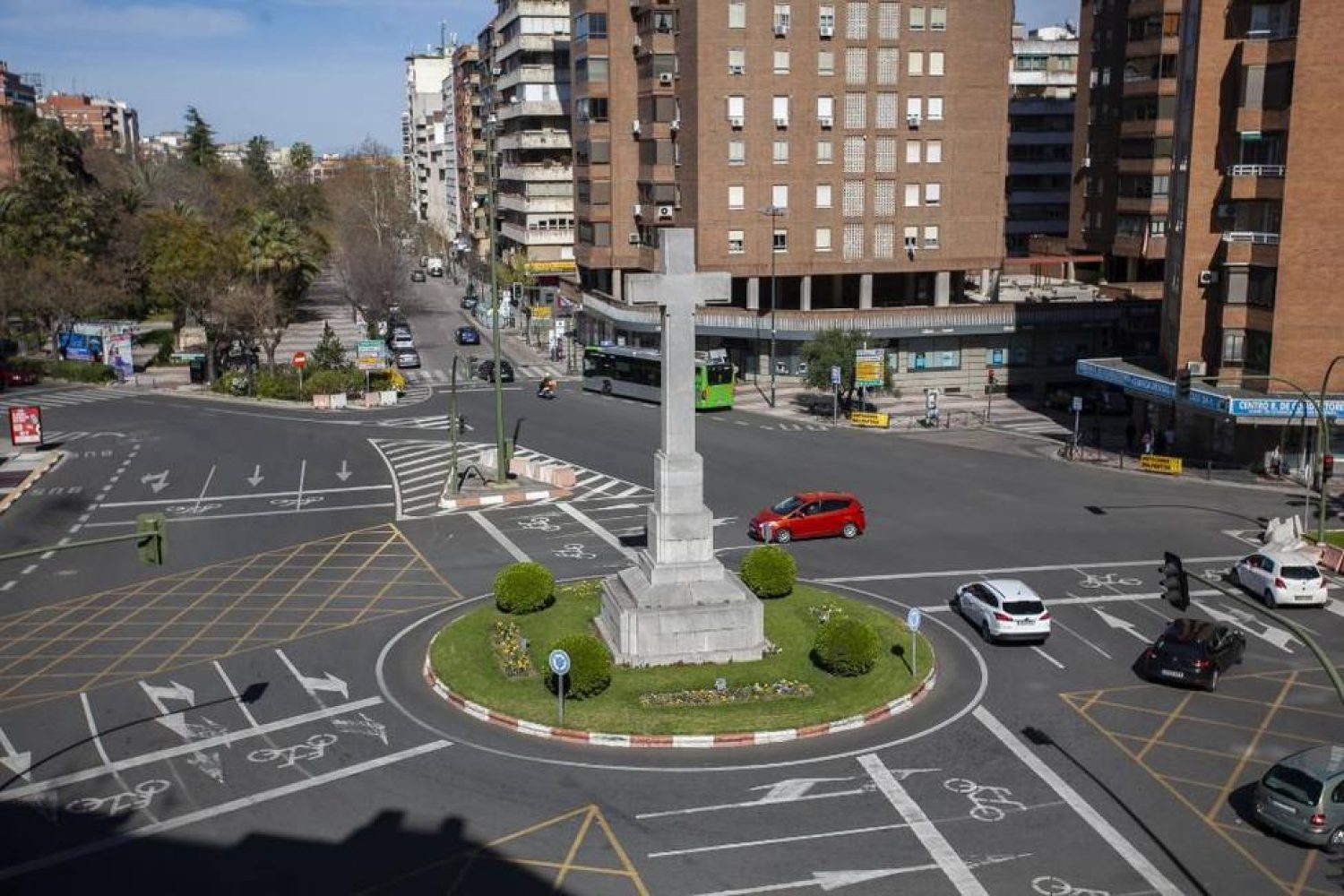
The Spanish government has given the city of Cáceres three months to remove a prominent Civil War-era cross after formally designating the monument as a symbol contrary to Spain’s democratic memory laws.
The Cross of the Fallen, which stands in Plaza de América in the western city of Cáceres, was added in April to the national catalogue of symbols and elements considered incompatible with the principles of Spain’s 2022 Democratic Memory Law.
The measure was accompanied by an order requiring its removal from public space, with the government arguing that the monument constitutes a Francoist symbol and lacks the artistic or historical significance necessary to justify an exemption.
The decision has been fiercely opposed by local and regional authorities, who insist the cross is primarily a religious monument and forms part of the city’s historic landscape rather than a political statement.
Rafael Mateos, the Popular Party mayor of Cáceres, has pledged to challenge the order through the courts. The city council argues that the monument has long since ceased to function as an instrument of political exaltation and that its presence in the city centre is now understood in a broader historical and cultural context.
Municipal officials have also raised procedural objections. According to the council, the original removal order issued in April was signed by an authority that lacked the legal competence to do so. Although the government later issued a fresh resolution in May, the city intends to contest that decision as well and seek a suspension of the deadline while legal proceedings are underway.
The dispute has drawn in the regional government of Extremadura, which has begun proceedings to grant the monument Bien de Interés Cultural status, Spain’s highest form of heritage protection. Such a designation would strengthen the case for preserving the cross and could complicate attempts to remove it.
Laureano León, Extremadura’s regional minister for culture, tourism and sport, has indicated that he believes the monument fulfils the criteria required for heritage protection.
Speaking to journalists before appearing before the regional parliament’s culture committee, León said the designation process was already under way and would continue through the normal administrative channels.
“Certainly, my opinion is that it meets the conditions,” he said, while adding that the final determination would depend on technical reports produced during the process.
The controversy has also become a flashpoint in wider political tensions between Madrid and Extremadura. The regional administration is governed by the Popular Party with the support of Vox, and both parties have defended the monument’s continued presence.
Álvaro Sánchez-Ocaña Vara, Vox’s deputy spokesman in the Extremadura Assembly, accused the central government of targeting the cross for political reasons and linked the dispute to the governing arrangement between Vox and regional president María Guardiola.
“The Cross is not to be touched,” Sánchez-Ocaña told reporters in Mérida.
He described the government’s resolution as “an outrage” and “political persecution”, arguing that the monument is “inherently religious, but above all historical and devoid of any political exaltation”.
Sánchez-Ocaña further maintained that the legal justification for removing the cross was flawed because the monument no longer serves any ideological purpose. He called on the government to allow the structure to remain in place while appeals are considered.
“We demand that the central government, until the appeal is resolved, leave the Cross where it is,” he said. “The Cross is the heritage of the people of Cáceres and it must remain so.”
The dispute centres on competing interpretations of the monument’s meaning nearly nine decades after it was erected. The cross was built in 1938 during the Spanish Civil War, a conflict that claimed hundreds of thousands of lives and culminated in the victory of General Francisco Franco’s Nationalist forces.
Throughout Spain, monuments dedicated to the “fallen” were erected during and after the war, often commemorating those who died fighting for the Nationalist cause. Many of these memorials incorporated overt political symbolism linked to Franco’s regime, while others took the form of large Christian crosses that remained in public spaces long after Spain’s transition to democracy.
Since the end of the Franco dictatorship, Spanish governments have grappled with how to address such monuments. Efforts to remove Francoist symbols accelerated under the Historical Memory Law of 2007 and were expanded significantly through the Democratic Memory Law adopted in 2022.
The legal challenge now being prepared by the city council is likely to determine whether the monument remains in Plaza de América or becomes the latest casualty of Spain’s long-running reckoning with the legacy of the Civil War and the Franco era.