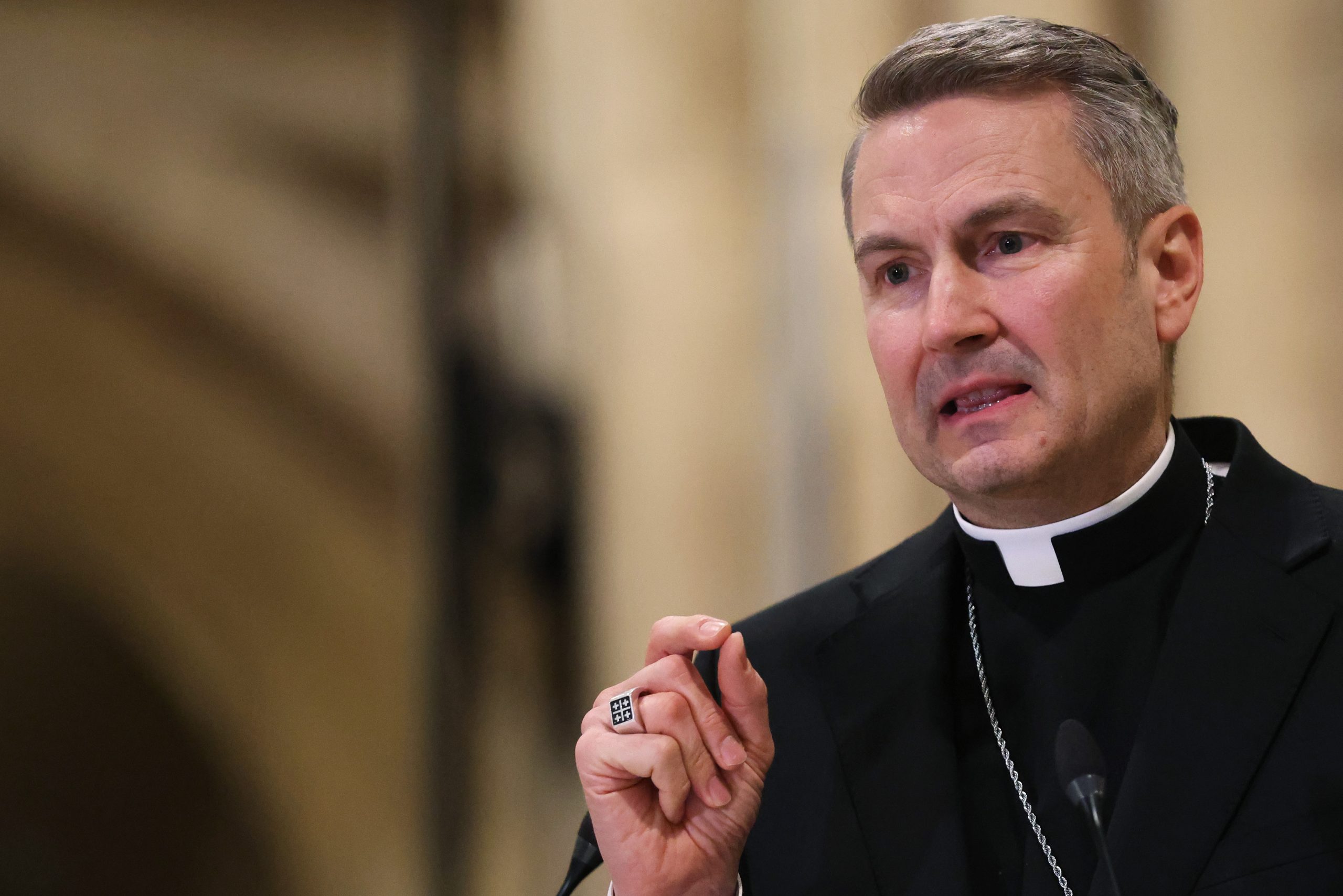
The German bishops have renewed pressure on Rome to permit women to be ordained as deacons, with Bishop Franz Jung of Würzburg declaring that the country’s episcopal conference had given Pope Leo XIV a “very clear vote in favour of the female diaconate”.
Speaking after the conclusion of the Katholikentag in Würzburg, one of Germany’s largest gatherings of Catholic laity and clergy, Bishop Jung said the question of women deacons remained firmly on the agenda of the Church and would not disappear “any time soon”.
“We, as the German Bishops’ Conference, have done everything we can,” he told Mainpost.de. “We have very clearly expressed our support in Rome for the diaconate of women. Now it is up to him how things proceed.”
The issue of women deacons has become one of the defining fault lines within the global Church in recent years, particularly since the launch of Germany’s Synodal Way in 2019 where German bishops and lay delegates repeatedly backed calls for expanded roles for women, including access to ordained ministries.
Pope Francis established two commissions during his pontificate to study the historical question of female deacons in the early Church, but neither resulted in any definitive change. Shortly before his death, Francis authorised the publication of findings from a Vatican study group examining the subject further, although no conclusions were reached on whether women could sacramentally receive the diaconate.
Bishop Jung suggested that the election of Pope Leo XIV had not diminished expectations among German bishops that movement might eventually come from Rome. “The issue is on the agenda,” he said, adding that the bishops were now “eager to see what happens”.
His intervention came after a Katholikentag heavily focused on questions of Church reform, political engagement and the role of Catholics in German public life. Held under the slogan “Have courage, stand up!”, the gathering drew senior politicians, clergy and lay activists for five days of debates, liturgies and public events across Würzburg.
Jung described the event as a success, praising what he called the “joie de vivre and festive spirit” of participants. He said the motto had resonated strongly because it connected with “personal, religious and socio-political” concerns at a time of growing division in society.
The event came under criticism after a video of the event appeared to show a woman holding a chalice and reciting the words of consecration while a priest stood behind her.
The bishop also defended the organisers’ decision not to invite representatives of the Alternative für Deutschland party, saying the AfD’s “view of humanity does not correspond to the Christian one”. He also pointed to what he described as the party’s “explicitly anti-church stance”. However, the event included other groups and speakers from outside the Church’s traditional structures.
The exclusion of the AfD continued the increasingly overt political tone adopted by sections of the German Church hierarchy in recent years, particularly on migration, nationalism and climate policy. Critics, however, argue that Church events have become excessively politicised and risk alienating ordinary Catholics concerned primarily with faith and worship.
Bishop Jung rejected those criticisms, insisting that the Katholikentag maintained a balance between political discussion and spiritual life. “Many people come to the Catholic Congress to recharge their spirits and pray together in a large community,” he said, adding that spiritual events during the gathering had been filled to capacity.
Among the highlights of the event, he said, was a discussion with former Green Party leader Ricarda Lang on the conference theme of courage and public witness. He also praised a youth prayer service featuring praise, worship and testimonies of faith, saying the enthusiasm of young Catholics had renewed his energy after an exhausting week.
The debate surrounding women deacons nevertheless overshadowed much of the wider discussion, continuing the tensions between the German Church and Rome over the direction of reform.
The Vatican has consistently distinguished the question of women deacons from the priesthood, but senior cardinals and theologians remain divided over whether historical evidence supports the existence of sacramental female deacons in the early Church.
Germany’s bishops have emerged as some of the strongest advocates for change. During sessions of the Synodal Way, delegates repeatedly approved texts calling for women to be admitted to ordained ministries, same-sex blessings and revisions to Catholic teaching on sexuality.
The Vatican responded on several occasions with unusually direct interventions. In 2022, the Holy See warned that the Synodal Way had “no authority” to oblige bishops and faithful to adopt new forms of governance or doctrine. A year later, senior German bishops were summoned to Rome for talks over mounting concern about the trajectory of reforms.
Yet despite those warnings, bishops such as Jung continue to present the female diaconate as unfinished business within the universal Church.
Asked whether he expected Pope Leo XIV to visit Germany in the near future, Jung said he could not say, but added that Würzburg would “certainly roll out the red carpet for him” should such a visit take place.