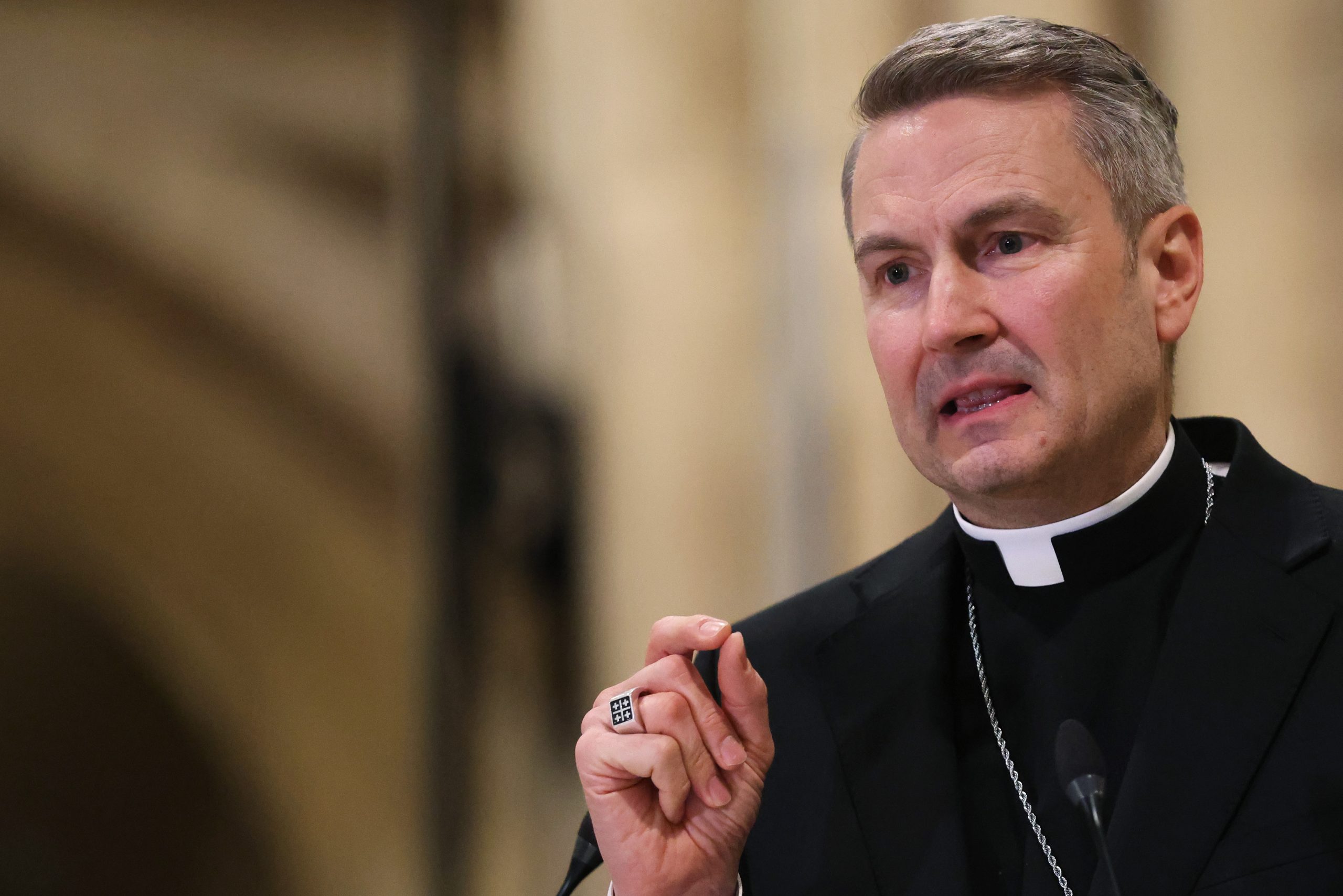
Cardinal Willem Jacobus Eijk has issued one of the strongest episcopal interventions yet against the Synod on Synodality’s treatment of moral theology. The Dutch Cardinal has warned that the final report of Study Group 9 risks undermining settled Catholic teaching on sexuality and the nature of moral truth itself.
Writing in the National Catholic Register, Cardinal Eijk said the report “fundamentally contradicts Catholic moral teaching and thoroughly undermines its application to moral conduct”, adding that the document “must be forcefully refuted”.
The report at the centre of the controversy, entitled Theological Criteria and Synod Methodologies for Shared Discernment of Emerging Doctrinal, Pastoral, and Ethical Issues, was produced by one of 10 study groups established by Pope Francis in February 2024 after the Synod assemblies concluded that insufficient time remained to address several contentious themes before the final Vatican gathering later that year.
Study Group 9 had been tasked with examining doctrinal and ethical questions initially described as “controversial”. The report later explained that the phrase had been replaced with “emerging issues” as part of what it called an “authentic paradigm shift” inspired by the reforms of the Second Vatican Council.
Particular controversy has surrounded the inclusion of testimonies from two men in same-sex “civil marriages”. One contributor from Portugal described building “a life of shared faith and service with my husband”, while another American witness wrote that his sexuality “isn’t a perversion, disorder, or cross; it’s a gift from God. I have a happy, healthy marriage and am flourishing as an openly gay Catholic”.
The report stated that one testimony “bears witness to the discovery that sin, at its root, does not consist in the (same-sex) couple relationship, but in a lack of faith in a God who desires our fulfilment”. Cardinal Eijk said the authors reproduced the statement “without correction or clarification”.
“Homosexual acts are intrinsically evil – this is settled Catholic doctrine,” Cardinal Eijk wrote. “A believing Christian who engages in such acts certainly falls short in faith, insofar as he fails to trust in God’s grace, which enables him to avoid sin. But this does not mean the sin lies primarily in lack of faith rather than in the act itself, as the witness suggests.”
His Eminence also criticised the report’s treatment of Courage International, the apostolate founded in New York in 1980 to help Catholics with same-sex attraction live according to Church teaching. The American testimony portrayed Courage negatively, suggesting that it “separates faith and sexuality” and associated it with conversion therapy.
Cardinal Eijk argued that by presenting such testimonies without doctrinal response, the report effectively normalised homosexual relationships within a Church context. “This represents a clear attempt to weaken the proclamation of Catholic moral teaching,” Cardinal Eijk said.
Much of Cardinal Eijk’s criticism focused not only on sexuality but on the report’s wider theological method. The study group rejected what it described as the “abstractly proclaiming and deductively applying principles that are set out in an immutable and rigid manner”, instead advocating what it termed a “fruitful tension” between doctrine and lived experience.
The report also insisted that discernment should avoid “a problem-solving perspective” and should not presume “to deduce action from the simple application of norms”. Instead, local Churches were encouraged to prioritise listening and dialogue rather than “pre-packaged” doctrinal solutions.
Cardinal Eijk said such language concealed “a radical departure from Catholic moral theology”. Referring to the report’s use of Christ’s words that “the Sabbath was made for humankind, and not humankind for the Sabbath”, His Eminence wrote: “This is a fundamental misreading of Scripture.”
Cardinal Eijk argued that the report confused changeable ritual law with the permanent moral law rooted in creation. “The moral law concerning marriage and sexuality is of an entirely different character,” Cardinal Eijk wrote. “These norms flow from the natural law, which reflects God’s purposes in creating human beings, marriage and sexuality itself.”
His Eminence then restated traditional Catholic teaching on marriage in classical terms, writing that “sexual differentiation and openness to life are essential elements” of marriage as a “mutual total self-giving between a man and a woman”. Cardinal Eijk added that “sexual acts between persons of the same sex cannot constitute such a total gift because they are closed to the transmission of life by their very nature”.
Study Group 9 repeatedly insisted that its aim was not to produce “generalisable solutions” but to initiate “processes in the form of listening”. The report argued that moral understanding should emerge gradually through dialogue across cultures and local Churches rather than through the direct application of universal norms.
For Cardinal Eijk, that approach strikes at the heart of Catholic moral teaching. “The Church’s teaching is not obscure, nor is it subject to revision through synodal processes,” Cardinal Eijk wrote. “It is the truth that sets us free.”
His Eminence concluded by stating that “a number of cardinals and bishops will make their objections known to the Roman Magisterium.”