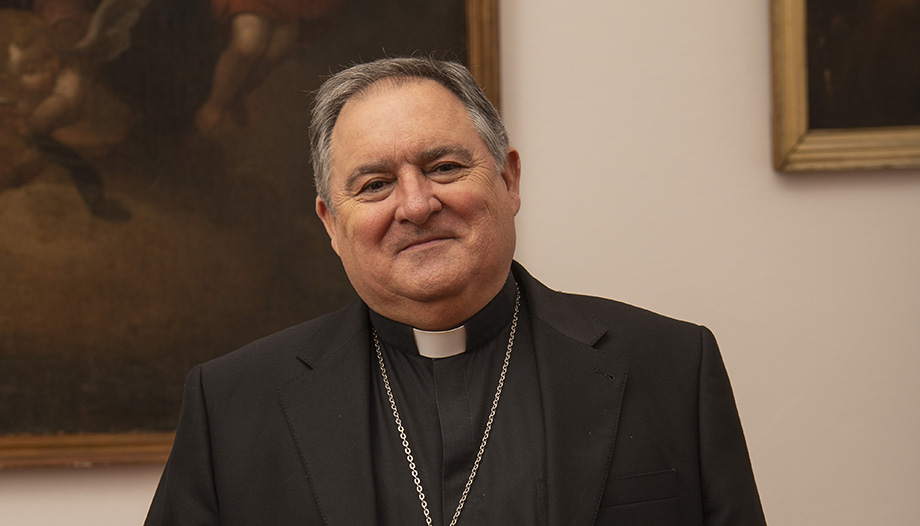
The Bishop of the Canary Islands has appealed for Spain’s political class to stop using immigration as a weapon of ideological warfare ahead of the forthcoming visit of Pope Leo XIV.
In an interview with the Spanish outlet The Objective, given as preparations continue for the Pope’s visit to Spain, Bishop José Mazuelos Pérez insisted that the migration crisis affecting the Canary Islands could not be reduced to electoral calculations or partisan rhetoric.
“Immigration cannot be used for political polarisation,” the bishop said. “It’s not a matter of polarising the issue and using it for an ideology to win votes, but rather of finding the most humane solutions possible.”
The Canary Islands have become one of the principal entry points into Europe for migrants crossing from West Africa, with local authorities struggling to cope with growing numbers of arrivals, especially unaccompanied minors. At the same time, debate over immigration has intensified sharply within Spanish politics, where both Left and Right accuse one another of exploiting the issue for political advantage.
Bishop Mazuelos criticised what he described as attempts by all sides to instrumentalise migration for electoral purposes. “Politicians have to stop playing politics with immigration and find a solution together,” the bishop said. “Enough is enough; it seems the common good has been lost.”
Over recent years, bishops, Catholic charities and ecclesiastical organisations have repeatedly backed measures designed to regularise migrants already living in Spain, while pressing for greater humanitarian protections and expanded reception policies. That stance has generated criticism that the Spanish hierarchy has aligned itself too closely with the assumptions of progressive migration policy while failing to address concerns surrounding integration, crime, pressure on housing and public services, and the wider social consequences of large-scale irregular migration.
Bishop Mazuelos acknowledged that the Church had supported the regularisation of migrants for more than a year. “The Church has been asking for it for over a year and a half,” he said, arguing that Spain depended heavily upon migrant labour, particularly in caring professions and among workers supporting the country’s ageing population.
At the same time, however, he openly criticised the political handling of the issue by the government of Spanish President Pedro Sánchez, suggesting that recent moves towards regularisation had been driven less by humanitarian concerns than by domestic political calculations. Referring to the timing of the proposals, the bishop said: “It was more because of the elections in Aragon than the Pope’s visit, because it suited their purposes.”
Bishop Mazuelos repeatedly invoked the need for a return to “the spirit of the Transition”, referring to the broad political consensus that accompanied Spain’s move from Francoist dictatorship to parliamentary democracy in the late 1970s.
“A large majority of Spaniards miss that spirit of the Transition,” the bishop said, expressing hope that Pope Leo XIV’s visit to the Spanish parliament might encourage politicians to rediscover a sense of national unity.
Pope Leo XIV is expected to visit Madrid, Barcelona and the Canary Islands during what will be his first visit to Spain as Pope and the first papal visit since Benedict XVI attended World Youth Day in 2011. The Canary Islands, now synonymous across Europe with the migration crisis in the Atlantic, make any papal appearance there impossible to separate entirely from politics.
Bishop Mazuelos insisted that the visit should not be interpreted as a political intervention. “The Pope’s visit to the Canary Islands is not political; he’s not coming to scold anyone or tell anyone what to do,” he said. Instead, he argued, the Pope wished to highlight “charity” and the wider mission of evangelisation.
Still, the bishop also made clear that Leo XIV would likely speak forcefully about the need for unity and human dignity in the face of political division. “Pope Leo XIV is going to make that call for unity,” he said. “Let’s not use immigration for votes.”
Bishop Mazuelos also addressed growing concerns over the treatment of unaccompanied migrant minors arriving in the Canary Islands, many of whom face uncertain futures upon reaching adulthood. “When they turn 18, they’re sent out onto the street,” he said, warning that many subsequently become vulnerable to criminal exploitation, prostitution and homelessness.
He praised the work of Caritas and Catholic organisations operating in the islands, arguing that Church agencies were frequently stepping in where the state had failed. “Ultimately, it’s Caritas that’s feeding them,” he said. “Helping them so often where the State falls short.”
The bishop nevertheless rejected accusations that the Church supported uncontrolled or irregular migration. “The Church is not in favour of irregular immigration,” he said. “But rather the most humane immigration possible.”