If you entered Our Lady Help of Christians in Luton town centre for the 7am Mass on a weekday morning in the 2010s, you were one of few. Luton, a town about an hour’s drive from England’s capital, is known for its poverty and its history of extremism. An outpost of Al-Muhajiroun, radical Muslims famously held Islamist rallies there to protest the return of fallen British soldiers from Afghanistan. It is also home to the English Defence League, founded by Luton native Tommy Robinson, who has become one of the most recognisable faces of Britain’s hard right.
There are many more mosques than Catholic churches in Luton. A parish priest in Bury Park, the town’s most densely Muslim area, once told me there were 16 mosques within his parish boundaries. Evangelicals also maintain a strong presence, particularly in High Town, an area with a large white working-class population. Hope Church, a Newfrontiers congregation, is particularly active in serving the town’s more marginalised residents.
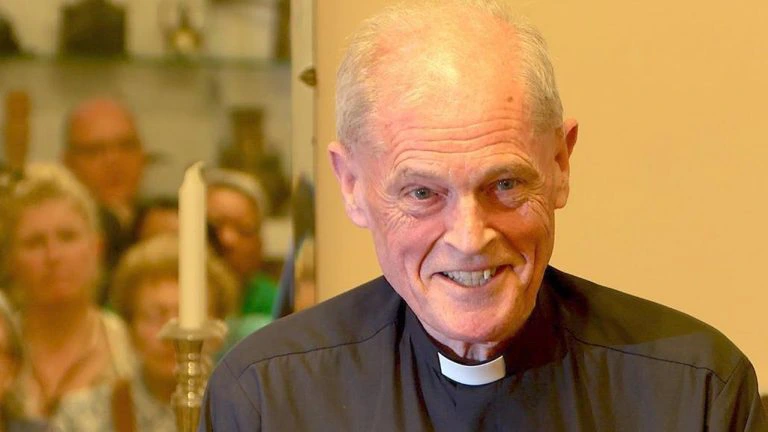
However, if you did enter Our Lady Help of Christians for the 7am Mass, you would likely have found yourself at a liturgy celebrated by Britain’s leading exorcist, Fr Jeremy Davies. Born in 1935 on the solemnity of the Annunciation, it was not expected that he would enter the priesthood. His father, a senior officer at RAF Fighter Command, left his wife and children to remarry, and there was still a healthy amount of anti-Catholic sentiment in civilised English society.
Raised in the last ripples of the Victorian era, he had the manners, etiquette and genteel disposition that was expected of his upper-middle-class background. He attended the King’s School, Canterbury, then studied English at St Edmund Hall, Oxford, before training in medicine at St Bartholomew’s Hospital, London. At the age of 31, having found life lacking in meaning, he converted to the Catholic faith. At 32, he left London to work as a doctor in missions in Guyana, Nigeria, and Ghana.
Sensing a call to the priesthood, he went to study in Rome at Beda College as a seminarian for the Diocese of Westminster and was ordained at the age of 39. His vocation was in part an intellectual effort which led him to a profound conviction in the truths of Catholicism. But it was also in reparation for doing something he described as “very wrong” and desiring to make atonement. Upon ordination, he was sent to Westminster Cathedral, the centre of English Catholicism, as a chaplain.
He spent almost 20 years as an assistant priest at St James’s, Spanish Place, one of London’s most prominent Catholic churches, where Edward VII attended the requiem Mass for King Carlos I of Portugal, the first British monarch to do so since James II. It was there that he trained as an exorcist. In 1994, together with Gabriele Amorth, he founded the International Association of Exorcists to encourage greater awareness among dioceses of cases of demonic possession. The association now has more than 200 members.
Of the 48 years Fr Davies served as a Catholic priest, 35 were spent as an exorcist in the Archdiocese of Westminster, where he became widely regarded as one of the leading figures in the field.
As an exorcist, Fr Davies was known for bringing his medical precision to the spiritual realm, freeing hundreds of people from demonic bondage. He was pragmatic in his approach and wrote a book for the Catholic Truth Society entitled Exorcism: Understanding Exorcism in Scripture and Practice.
After many years as a parish priest, his role as assistant priest in Luton brought him to a quieter life, but nonetheless still carrying out his priestly ministry, offering spiritual direction to anyone who asked for it and waiting patiently in the Church’s sacristy to meet troubled souls.
In 2021, he retired to Walsingham, England’s Nazareth, indicative of his devotion to Our Lady. He is buried within the confines of the national shrine. Fr Davies gave instructions for his funeral Mass that the congregation should be told that no one should assume that he was already in heaven. A sobering thought for such a holy man. He was insistent that salvation should not be presumed, but rather hoped for and prayed for.
He died on 5 November 2022, a date long associated with anti-Catholic hostility in England following the Gunpowder Plot. For a gentleman priest, thoroughly English and able to navigate such apparent contradictions with finesse, he would have found the timing of his departure quietly amusing.