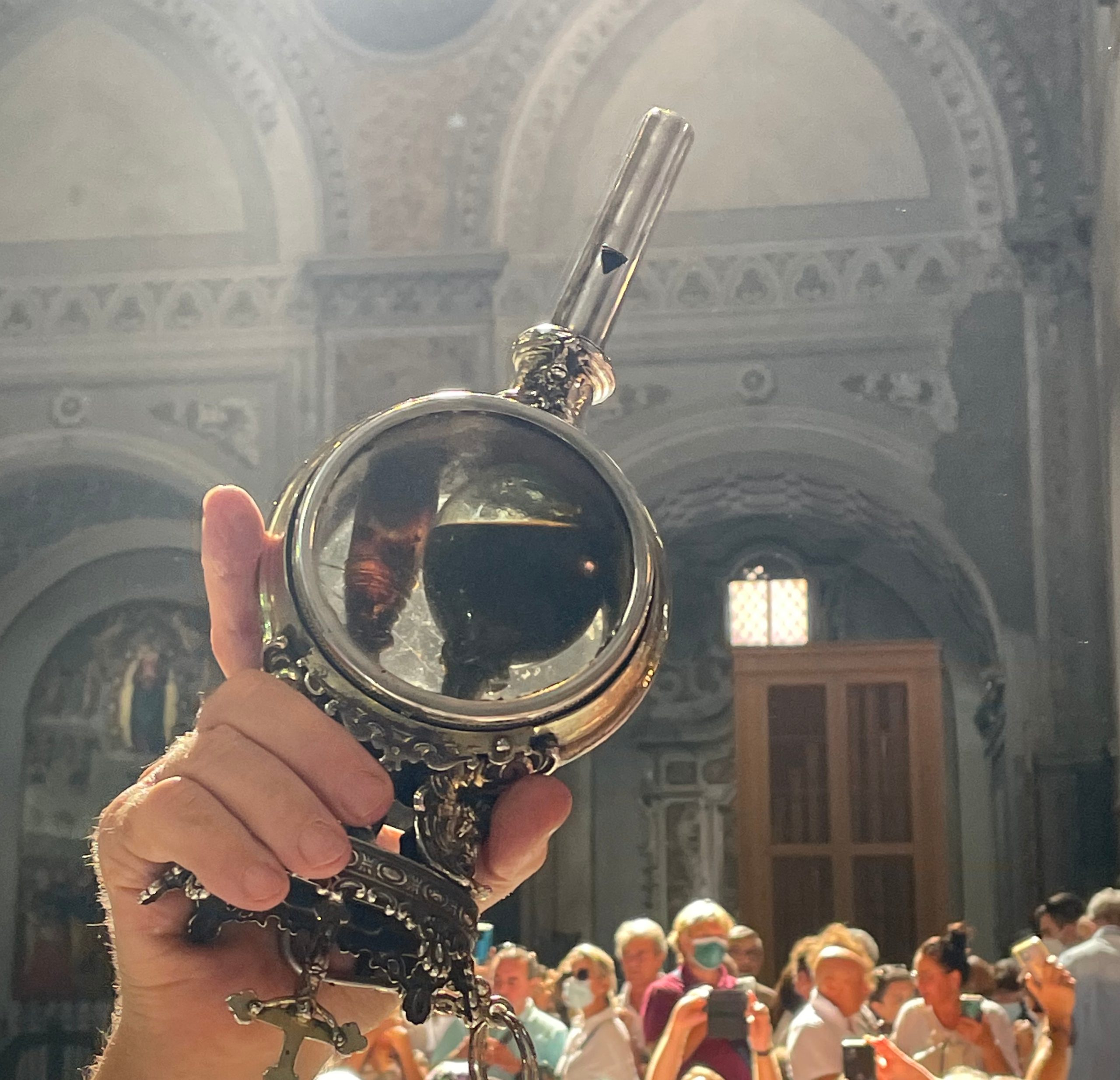
The liquefaction of the blood of Saint Januarius was reported in Naples on Friday shortly before the arrival of Pope Leo XIV.
The miracle took place at Naples Cathedral, where the relics of the city’s patron saint, known locally as San Gennaro, are preserved. The substance contained in the larger of two sealed ampoules appeared to liquefy on the Pope’s arrival and while the Holy Father was holding it, despite the event falling outside the three dates each year on which the phenomenon is traditionally expected.
The liquefaction was witnessed as Naples welcomed Leo XIV during a pastoral visit marking the first anniversary of his pontificate. The Pope later travelled through the city before addressing crowds gathered in Piazza del Plebiscito, where he urged Naples to become a “workshop of peace”.
“There is no peace without justice,” the Pope said. “And justice is not complete without charity.” He warned against allowing entire neighbourhoods to fall into neglect and exclusion, describing what he called a modern “geography of inequality” stretching across both the historic centre and the outskirts of the city. He stressed the importance of strong public institutions capable of restoring trust and opportunity, particularly for young people.
Pope Leo also praised those he described as the “everyday heroes” of Naples, the priests, volunteers, teachers and families who continue quietly working for the common good despite difficult social conditions. Their efforts, he said, should not remain isolated acts but become part of a wider “network of good” capable of strengthening the social fabric of the city.
The Pope repeatedly returned to the role of the Church in helping rebuild civic life, praising cooperation between parishes, schools and charitable organisations. He said Naples should not become merely a “postcard city” shaped only by tourism, but a place where solidarity, education and human dignity are defended in practical ways. He also commended the city’s longstanding openness towards migrants and refugees, describing hospitality not as an emergency response but as “an opportunity for encounter and mutual enrichment”.
According to long-standing tradition, a woman named Eusebia collected the saint’s blood after his execution. It is today preserved in two hermetically sealed glass ampoules held within a silver reliquary in Naples Cathedral.
The phenomenon normally occurs three times a year: on September 19, the feast of Saint Januarius; on the Saturday before the first Sunday in May, commemorating the reunification of his relics; and on December 16, marking his patronage of Naples.
Thousands of pilgrims routinely gather in the cathedral on those dates to witness the ceremony, during which the reliquary is brought from the cathedral treasury and presented for veneration. The dark red substance inside the larger ampoule is initially shown in solid form before, in most cases, appearing gradually to liquefy during prayers offered by the faithful.
The ritual surrounding the relics has remained largely unchanged for centuries. The ampoules are stored in a secure vault, while bone fragments of the saint are kept beneath the cathedral altar. During the ceremony, the reliquary is repeatedly tilted to demonstrate whether liquefaction has taken place.
The miracle did not occur during the visit of Pope St John Paul II in 1979 or during the visit of Pope Emeritus Benedict XVI in 2007. During Pope Francis’s visit to Naples in 2015, the blood was said to have partially liquefied. Cardinal Crescenzio Sepe remarked at the time: “The blood has half liquefied, which shows that Saint Januarius loves our Pope and Naples.” The phenomenon was also reported during the visit of Blessed Pius IX in 1848.
The blood failed to liquefy in September 1939 and September 1940 during the Second World War, in September 1943 during the Nazi occupation of Naples, and in December 2020 amid the coronavirus pandemic.